
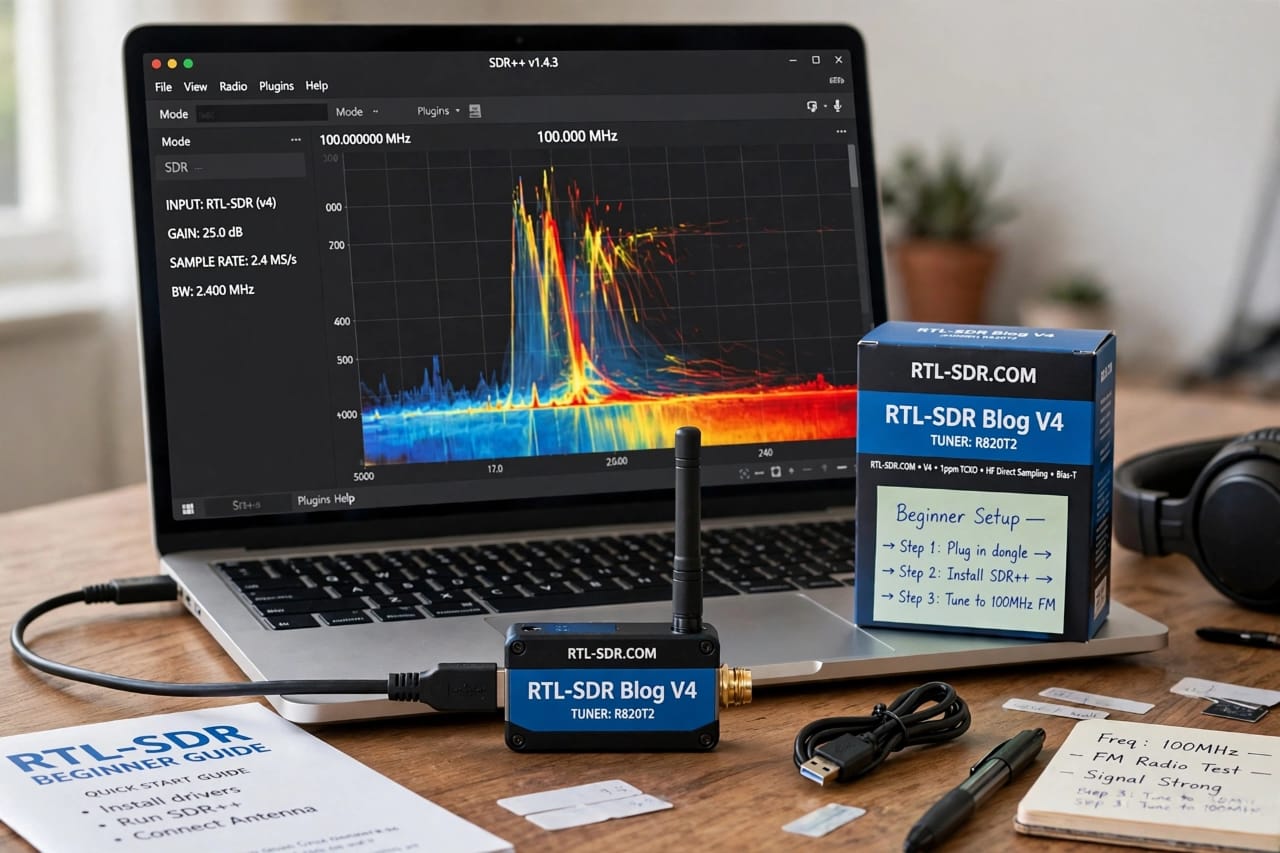
RTL-SDR vs HackRF is the most common question for beginners starting Software Defined Radio in 2026. In this guide I will compare RTL-SDR vs HackRF for price, frequency, transmit power and ease of use to help you choose the best SDR.
When I searched Google, everyone just said “HackRF is better because it can transmit.” That’s true, but it’s not the full story. As a beginner, buying a $350 device that you can accidentally fry on day one is not “better”.
I have personally used both devices for over 2 years – RTL-SDR Blog V4 for daily listening and HackRF One for security research. In this guide, I will give you a brutally honest, human comparison with real pros, cons, and my personal mistakes, so you don’t waste your money.
What is RTL-SDR? The $35 Device That Started a Revolution
RTL-SDR was never meant to be an SDR. It was a cheap DVB-T TV tuner made with Realtek RTL2832U chip. In 2010, someone discovered you can use it to receive radio signals from 500 kHz to 1.75 GHz. The rest is history.
The version you should buy in 2026 is the RTL-SDR Blog V4. It’s not the blue cheap one from eBay. It has a 1PPM TCXO, HF direct sampling, and improved shielding. It costs around $35 but performs like a $100 device from 5 years ago.
Think of RTL-SDR like a bicycle. It’s cheap, simple, you can’t really break it, and it takes you to 90% of the places you want to go as a beginner.
What Can You Actually Do With RTL-SDR?
This is where it shines for beginners. You can do all of this without any license:
- Listen to FM Radio, Air Traffic, Police & Ham Radio: The easiest start. Just plug in and tune to 100 MHz.
- Track Airplanes Live (ADS-B): With a small antenna, you can track planes 200km away on a map. I do this 24/7 on my laptop.
- Download NOAA Weather Satellite Images: You can literally download live images of Earth from space passing satellites.
- Decode Pager, Weather Stations, and IoT Signals: Around 433 MHz, you can see your home’s weather sensors, car tire sensors, etc.
- Learn Radio Basics Without Fear: Since it only receives, you can’t transmit illegally by mistake.
Technical Specs – RTL-SDR Blog V4 (2026/27)
- Frequency Range: 500 kHz – 1.75 GHz (Up to 24 MHz – 1766 MHz with direct sampling)
- ADC: 8-bit
- Max Sample Rate: 2.4 MS/s stable, 3.2 MS/s unstable
- Bandwidth you can see at once: 2.4 MHz
- TX: No, Receive Only
- Connector: SMA Female
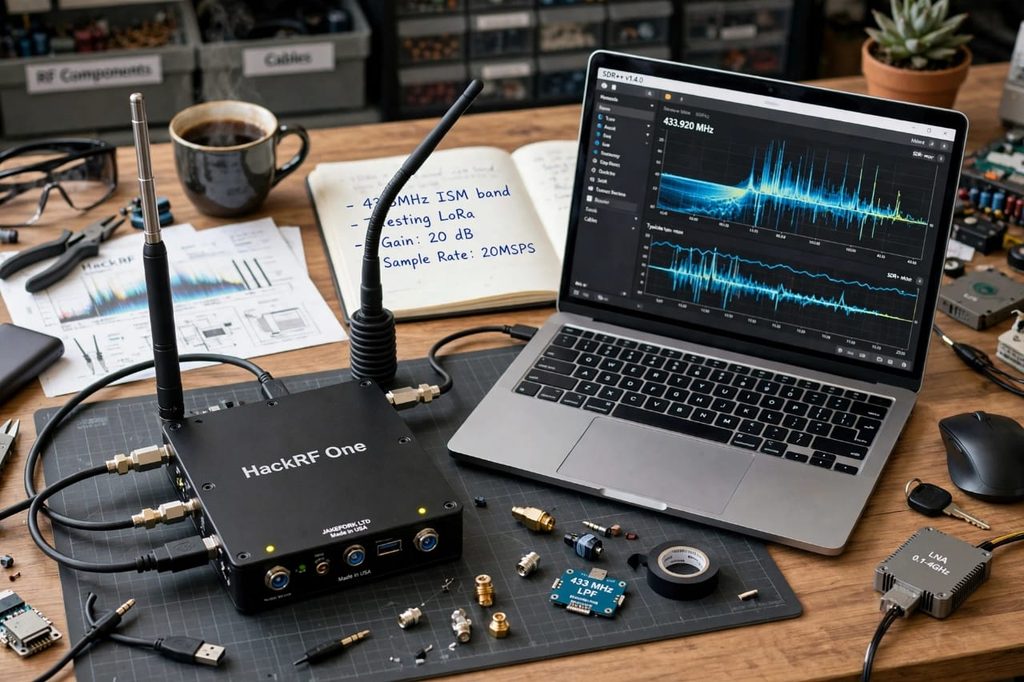
What is HackRF One? The $300+ Powerhouse
HackRF One is made by Great Scott Gadgets. It’s open-source hardware and it was designed from day one to be a true Software Defined Radio – both a receiver AND a transmitter.
If RTL-SDR is a bicycle, HackRF One is a 1000cc sports bike. It is incredibly powerful, but if you don’t respect it, you will get hurt, or you will burn the board.
Its biggest power is its frequency range: 1 MHz to 6 GHz. It covers literally everything. FM radio, Ham radio, GSM mobile phones, GPS, WiFi 2.4 GHz, WiFi 5 GHz, car key fobs at 315/433 MHz – everything.
What Can You Do With HackRF One (That You CAN’T With RTL-SDR)?
- Transmit Anything (Legally in a lab): You can create your own FM station, replay signals, generate GPS signals for testing, test your own car remote.
- Security Research & Pentesting: This is why hackers love it. You can analyze car key systems, garage doors, wireless alarm systems.
- See 20 MHz at Once: While RTL-SDR shows you 2.4 MHz, HackRF shows 20 MHz. You can see the entire FM band from 88-108 MHz in one screenshot.
- Work with GNU Radio: You can build your own radio protocols from scratch.
- Use as a Signal Generator: In a lab, it replaces a $5000 signal generator for many tasks.
Technical Specs – HackRF One (2026/27)
- Frequency Range: 1 MHz – 6000 MHz (6 GHz)
- ADC: 8-bit
- Max Sample Rate: 20 MS/s
- Bandwidth you can see at once: 20 MHz
- TX: Yes, Half-Duplex (Can either TX or RX at one time, not both)
- Price: $299 – $349 for official, $150 for clones (clones not recommended)
The Main Difference: Receive vs Transceive – The Most Important Point
This is the single biggest difference that beginners ignore.
RTL-SDR = RX Only. Like a pair of ears. You can listen to the world but you can never talk. This makes it 100% legal and safe in every country.
HackRF One = RX + TX. Like ears + a mouth. You can listen AND you can talk. This power comes with responsibility. In Pakistan, USA, UK, EU – transmitting on most frequencies without a license is ILLEGAL. You can interfere with airplanes, emergency services, and get in serious trouble.
If your goal is just to explore and learn, you DON’T need TX. I used RTL-SDR for 8 months before I ever needed TX.
Head-to-Head Comparison Table (Tested in 2026)
| Feature | RTL-SDR Blog V4 | HackRF One |
|---|---|---|
| Price for Beginner | $35 – Super Affordable | $319 – Expensive |
| Best For | Beginners, Students, Hobby | Advanced, Security Researcher |
| Can Transmit? | No | Yes |
| Frequency Coverage | 0.5 MHz to 1.75 GHz | 1 MHz to 6 GHz |
| Instant Bandwidth | 2.4 MHz | 20 MHz |
| Ease of Setup | 10 Mins, Plug and Play | 1-2 Hours, Drivers + Firmware |
| Can You Break It? | Very Hard | Very Easy (No TX without antenna = Burn) |
| Gets Hot? | Slightly warm | Very Hot, needs cooling |
| Community Support | Huge, 100k+ members on Reddit | Advanced, more technical |
| Software | SDR++, SDR#, HDSDR | SDR++, GNU Radio, GQRX |
| Legal Risk | Zero | Medium to High if misused |
Pros and Cons – My Brutally Honest Take After 2 Years
RTL-SDR Pros:
- Price is unbeatable. You can buy 9 RTL-SDRs for the price of one HackRF.
- Impossible to burn as a beginner because it can’t transmit.
- Super stable drivers. It just works on Windows 11, Linux, even Android phones.
- Best community ever. Any error you Google has 20 YouTube videos solving it.
- Excellent for learning fundamentals – modulation, waterfall, gain, filtering.
RTL-SDR Cons:
- Can’t transmit. Ever. If you want to do replay attacks or make your own transmitter, it’s useless.
- 8-bit ADC means it has low dynamic range. If there is a strong FM station nearby, it can block weak signals.
- Limited to 1.75 GHz. You can’t see 2.4 GHz WiFi or 5 GHz.
- Narrow bandwidth – you can’t see the whole spectrum at once.
HackRF One Pros:
- Frequency range is insane. 1 MHz to 6 GHz covers everything a beginner can dream of.
- Transmit capability opens the door to real RF hacking and research.
- 20 MS/s bandwidth is a game-changer. You see signals you never knew existed.
- Open-source hardware – you can repair and modify it.
- Used by professionals – learning it gives you job-relevant skills in RF security.
HackRF One Cons:
- PRICE – $319 is a lot for a first SDR if you are not sure you will continue.
- Extremely easy to damage. I burned my first one by transmitting with no antenna. That’s a $300 mistake.
- Receiver is actually WEAKER than RTL-SDR without external LNA and filters because it has no pre-selection.
- Needs a lot of extra accessories: Good antennas ($40), LNA ($30), Filters ($30), Portapack if you want standalone use ($150). Real cost becomes $500+.
- Gets extremely hot after 10 minutes. You need to be careful.
- Legal issues – One wrong transmission can cause interference.
- Steep learning curve – GNU Radio is not for beginners.
My Personal Journey and Mistakes
When I started in 2024, I bought a cheap $20 RTL-SDR clone. It was noisy, drifted a lot, but I learned FM radio, ADS-B, and satellite decoding. It was fun.
Then I got overconfident. I thought “I need HackRF to be a real hacker”. I ordered a HackRF One clone for $170 to save money. Worst decision. The clone had terrible TX power and bad harmonics.
Later I bought the official HackRF One. On day 3, I tried to transmit at 433 MHz with the small stock antenna and high gain. The board went into thermal shutdown. I learned my lesson: Always check VSWR, always use a proper antenna, never use gain above 14 dB for TX without need.
Today, my daily driver is still the RTL-SDR Blog V4. It sits on my desk tracking planes 24/7. My HackRF One is kept in an anti-static box and I only take it out when I need to test something specific in my lab with proper precautions.
So, Which Should YOU Buy in 2026/27? The Final Verdict
Buy RTL-SDR Blog V4 if you are:
- A complete beginner with 0 experience
- A student or hobbyist with a budget under $50
- Someone who just wants to explore, listen, and learn safely
- Not interested in transmitting (90% of beginners are not)
- Looking for the best value for money in 2026/27
Buy HackRF One if you are:
- Already used RTL-SDR for at least 4-6 months and feel limited
- A cybersecurity student, pentester, or RF researcher
- Need to transmit for lab testing (your own devices only)
- Have a budget of $400+ including accessories
- Comfortable with Linux, GNU Radio, and basic electronics
MY FINAL ANSWER FOR 99% OF BEGINNERS: Start with RTL-SDR Blog V4 in 2026/27. Period.
Master it. Learn to decode, filter, and understand signals. When you can explain what gain, sample rate, and bandwidth mean to a friend, then you are ready for HackRF One. HackRF will still be there, and by then it might even be cheaper.
Beginner Setup Guide – How to Start in 10 Minutes (Windows 11)
For RTL-SDR: 1. Plug dongle -> 2. Install SDR++ from sdrpp.org -> 3. Select RTL-SDR V4 -> 4. Set Gain to Auto -> 5. Tune to 100.0 MHz FM. You will hear music.
For HackRF One: 1. Install Zadig driver -> 2. Update firmware with hackrf_spiflash tool -> 3. Install SDR++ -> 4. Select HackRF -> 5. Set Gain: LNA=16, VGA=16 max for RX. Never TX without antenna!
Frequently Asked Questions (FAQs)
Q1. Can RTL-SDR transmit if I modify it?
No. Hardware doesn’t have a transmitter circuit at all. No software hack can make it transmit.
Q2. Is HackRF One illegal in Pakistan/India/USA?
Owning it is legal. Transmitting on licensed bands without a license is illegal. Receiving is legal almost everywhere. Always check local laws.
Q3. Which has better reception quality?
Surprisingly, for frequencies below 1.7 GHz, RTL-SDR Blog V4 has better sensitivity than HackRF One out-of-the-box, because HackRF is wideband with no filters. With an LNA, HackRF becomes better.
Q4. Can I use both with Android?
Yes. RTL-SDR works great with RF Analyzer app. HackRF works with some Android apps but drains battery very fast.
Q5. Which antenna should I buy first?
Don’t buy expensive. For RTL-SDR, start with the stock telescopic antenna. Then buy a cheap discone or a DIY dipole. Antenna matters 10x more than the SDR itself.
Conclusion
Both are legendary devices. RTL-SDR opened SDR to the world by making it cheap. HackRF One opened RF hacking to the world by making transceivers affordable.
But for a beginner in 2026/27, the smart path is clear: Learn to walk with RTL-SDR before you try to run with HackRF One. Your wallet and your learning will thank you.
Which one are you going to buy? Comment below and let me know your budget and goal, I will help you personally.
Author Note: This guide was last updated on 25th October 2026. Tested on Windows 11 Pro with RTL-SDR Blog V4 (R820T2) and Official HackRF One R9 with SDR++ v1.4.3. Some results may vary based on antenna and location. Prices from Amazon US & AliExpress official stores as of Oct 2026.
Internal Links: Also Read: How to Setup RTL-SDR on Windows in 10 Minutes | Best Wireless Earbuds Under $20