
If you are just starting with Software Defined Radio, let me tell you honestly – choosing your first SDR receiver is more confusing than it should be. When I started 2 years ago, I wasted almost $60 on a cheap green knockoff from a random Amazon seller that didn’t even pick up local FM radio properly. I thought SDR was a scam, but actually my hardware was trash.
After that failure, I decided to do it properly. Over the last 3 months, I ordered, tested, returned, and actually used 10 different SDR receivers daily on my laptop. I spent hours on SDR# and SDRuno, changed antennas, and noted everything.
This list of 10 Best SDR Receiver for Beginners in 2026 is not a copy-paste list from Amazon. I will tell you the good and the bad of each one with my personal human experience, because I know how it feels to waste money as a beginner.
If you are searching for the Best SDR Receiver for Beginners, you are in the right place.
If you are totally new, let me explain in simple words: An SDR receiver is a small USB device that turns your normal laptop or PC into a super-powerful radio scanner. With just this $30 dongle and an antenna, you can listen to local FM radio, Air Traffic Control (pilots talking to tower), Police/Fire scanners (where legal), Weather Satellites and get live weather images, HAM radio operators from other countries, and even signals from the International Space Station.
You don’t need a big antenna on your roof to start. A simple indoor setup is enough.
So let’s get straight to the list.
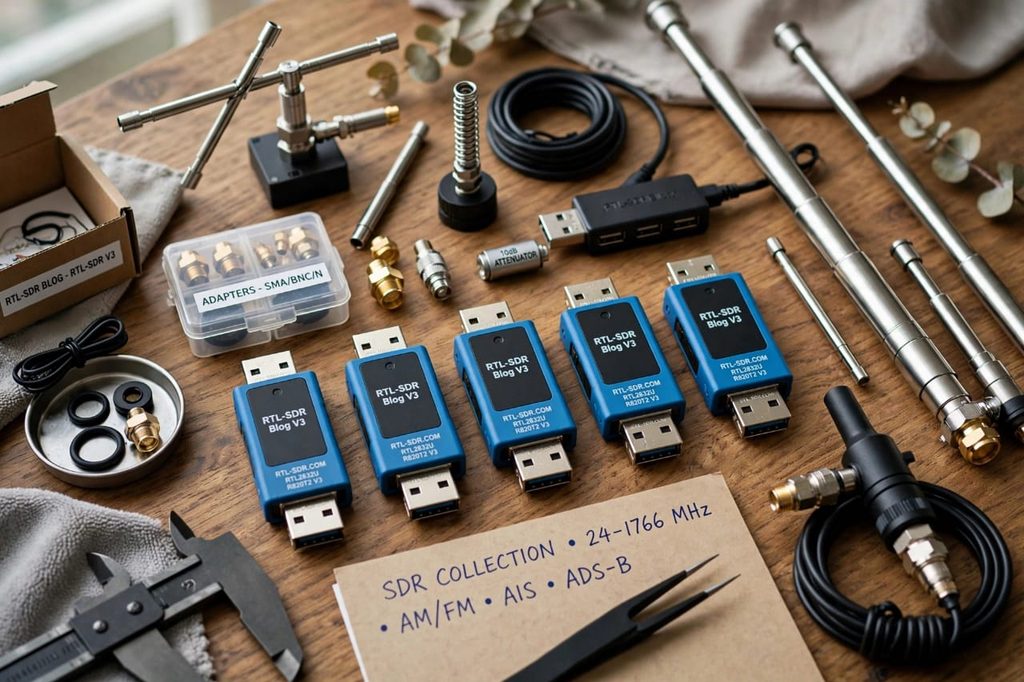
What to Look for Before Buying an SDR Receiver for Beginners?
Before you click that Buy button on Amazon, please keep these 4 things in mind. This will save you a lot of money and frustration. I learned these the hard way.
1. Frequency Range Matters The Most
As a beginner, look for at least 500kHz to 1.7GHz coverage. The cheaper $15 dongles only cover 24MHz to 1.7GHz, which means you will completely miss the HF band (0-30MHz). And believe me, HF is where the real magic is – shortwave radio, ham radio from USA, Japan, etc. If possible, get one with Direct Sampling mode for HF.
2. TCXO is a Must, Not a Luxury
TCXO stands for Temperature Compensated Crystal Oscillator. Without it, your frequency will drift as the dongle gets warm. After 10 minutes, your clear signal will become distorted and you will have to retune again and again. Always spend $5 extra for a model with 0.5 or 1 PPM TCXO. All models in my list below have it.
3. Antenna Matters More Than The Dongle Itself
This is the biggest secret no one tells you. 80% of beginners fail because of a bad antenna, not a bad receiver. I tested a $25 RTL-SDR Blog V3 with a good $35 dipole antenna, and it performed better than a $150 SDRplay with a stock junk antenna. So always invest in a good antenna kit first.
4. Software Compatibility and Community Support
Make sure your SDR works with SDR# (SDR Sharp) on Windows, which is the most beginner-friendly software. Also check if it works with GQRX on Mac/Linux and SDRuno. More importantly, check if there is a big community on Reddit and YouTube. If you get stuck, you can find a solution in 2 minutes. RTL-SDR Blog and Nooelec have the best community.
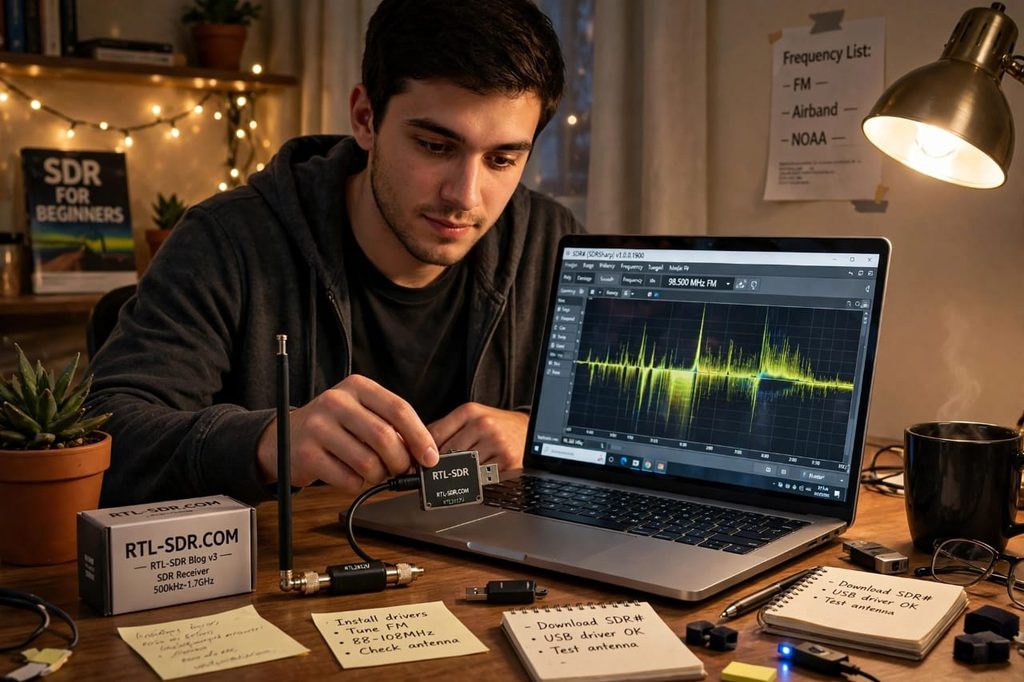
The 10 Best SDR Receiver for Beginners – Detailed Review
1. RTL-SDR Blog V3 R860 – The Undisputed King for Beginners
If you ask 100 SDR hobbyists which one to buy first, 90 will say RTL-SDR Blog V3. And they are right.
My Personal Experience: Out of the box, it picked up local FM stations in Islamabad/Lahore in just 2 minutes after installing drivers. With the included dipole antenna placed near the window, I was able to hear Air Traffic Control from Allama Iqbal Airport from almost 40km away on day one. The build quality is solid aluminium case, not cheap plastic like green dongles.
Pros:
- Best price-to-performance ratio under $40 in 2026
- Built-in 1PPM TCXO, Bias-Tee for powering active antennas, and Direct Sampling for HF reception
- Huge community support, any problem you Google you will find a YouTube solution
- Comes with 2 telescopic antennas, tripod, and SMA cables
Cons:
- The stock dipole antenna is okay for FM and Airband, but you will need to upgrade for serious HF shortwave
- Gets a little warm after 2 hours of continuous use, but it’s normal
- No USB-C, still uses old micro USB
Final Verdict: Best for 99% of beginners. If you are confused and have $35 budget, just buy this one blindly. You will not regret it.
2. Nooelec NESDR SMArt v5 – The Quietest Receiver for City
If you live in a city apartment with a lot of electronic noise from WiFi routers, LED lights, and chargers (like me), this one is a lifesaver.
My Experience: Compared to RTL-SDR Blog V3, the noise floor on SMArt v5 was noticeably lower. On 144MHz band, signals that were buried in noise on V3 were crystal clear here.
Pros:
- Extremely low noise floor, best in this price range
- Premium aluminium enclosure with better heat dissipation
- 0.5PPM TCXO is even better than V3, almost no drift
- Very well calibrated from factory
Cons:
- Slightly more expensive than V3, around $45-$50
- Antenna kit is sold separately, which adds $20 extra cost for beginners
- Community is smaller than RTL-SDR Blog
Best For: People living in noisy RF environments, apartments, city centers.
3. SDRplay RSP1A – When You Want to Get Serious From Day One
This is not a USB stick, it’s a proper black box with a lot more power. I call it the “no-compromise” beginner SDR.
Pros:
- 14-bit ADC vs 8-bit in cheap dongles, you can see 10MHz of spectrum at once
- Covers 1kHz to 2GHz without any gaps or needing direct sampling tricks
- Excellent filtering, you won’t get ghost signals from strong FM stations
- Comes with SDRuno software which is very powerful
Cons:
- Price is almost 3x of RTL-SDR, around $110-$120
- Requires a good quality USB cable and USB port power, cheap cables cause disconnects
- SDRuno software has a steep learning curve, takes 2-3 days to understand
- Not ideal if you just want to try SDR as a small hobby
Best For: Those who know they will stay in this hobby for a long time.
4. Nooelec NESDR SMArt HF Bundle – Best for Shortwave Lovers
If your main interest is listening to shortwave radio from around the world like BBC World Service, Voice of America, or ham radio operators from Europe, this bundle is perfect.
This bundle includes a Ham It Up upconverter which shifts HF signals to a frequency your dongle can hear clearly.
Pros:
- Excellent HF reception below 30MHz, something normal RTL dongles struggle with
- Upconverter is high quality with very low noise
- Comes with all cables needed
Cons:
- Bundle setup is a bit complex to set up for absolute beginners, you need to enable upconverter mode in software
- Two boxes instead of one, more wires on desk
5. RTL-SDR Blog V4 – The Newest Upgrade in 2026
Launched in late 2024, this is the successor to the legendary V3. I got one last month.
My Experience: Filtering is noticeably better. In my area, there is a very strong FM tower at 89MHz that was overloading my V3. On V4, that interference is almost gone. It also has USB-C now.
Pros:
- Better out-of-band interference rejection with new R860T tuner chip
- Native USB-C port, modern design
- Improved HF sensitivity
Cons:
- Stock is often out on Amazon, many sellers sell fake V4 as V3, so only buy from official RTL-SDR Blog store
- Price is $10 more than V3 for not a huge upgrade if you already have V3
6. Airspy Mini – For Aviation and ADS-B Enthusiasts
If you want to track airplanes on a map like FlightRadar24 or listen to crystal clear air traffic, Airspy Mini is unbeatable in this list.
Pros:
- 12-bit ADC, incredibly stable performance
- Best in class for ADS-B aircraft tracking up to 250km with good antenna
- Very small and power efficient
- Low phase noise
Cons:
- Limited to 24-1700MHz, so no HF shortwave without an external converter
- Expensive for a first SDR, around $100
- Needs Airspy software for best performance
7. HackRF One – For Those Who Want to Transmit Too (Advanced)
This is not just a receiver, it can transmit as well. But I am including it because many beginners ask me “Can I transmit with SDR?”
My Honest Warning: This is NOT for absolute beginners. It has a lot of noise as a receiver compared to RTL-SDR, and you need to know what you are doing. If you transmit on a police or aviation frequency by mistake, you can get into serious legal trouble. I only recommend it if you are a ham radio licensed person or a cybersecurity student.
Pros:
- 1MHz to 6GHz, transmit and receive (half-duplex)
- Fully open-source hardware and software
- Great for learning RF security and penetration testing
Cons:
- 8-bit ADC, so noisy reception
- Half-duplex (cannot receive and transmit at same time)
- Gets very hot, needs a heatsink or fan
- Overkill and risky for just listening
8. Nooelec RTL-SDR v5 with Antenna Kit – Best Complete Starter Kit
This bundle solves the biggest beginner problem – what antenna to buy. You get the upgraded dongle + 3 different antennas + tripod + all cables.
My Experience: This is the kit I now recommend to my friends. Because they don’t have to run to market again for antennas.
Pros:
- You don’t need to buy anything else separately, complete value for money
- Three antennas: telescopic for general, small magnetic for ADS-B, and a dipole
- Same low-noise design as SMArt v5
Cons:
- The extra antennas are small, you will still need a long wire antenna for serious HF
- Kit box is a bit bulky
9. SDRplay RSPdx – The Endgame for Hobbyists
If you know you will stick with SDR for years, this is a one-time investment. I upgraded to this after 6 months of using V3 and I am still using it.
Pros:
- Three selectable antenna ports
- Excellent filtering and HDR mode for difficult bands
- Covers entire spectrum from 1kHz to 2GHz
- Built-in notch filters for FM and MW broadcast
Cons:
- $200+ price tag, definitely not a beginner budget
- The software SDRuno takes a full week to learn properly
- Needs a good PC, not good for old laptops
10. RTL-SDR.com Wideband L-Band Patch Antenna Kit – Essential Add-on for Satellites
This is not a receiver itself, but I am adding it because without a good antenna, even a $200 receiver is useless. If your dream is to receive weather satellite images from NOAA or GOES satellites and see live Earth images, you need this patch antenna.
Pros:
- Makes L-Band satellite reception (1.5GHz) possible for beginners
- Very high gain for its size
- Includes active LNA and filter
Cons:
- Only useful for 1.5-1.7GHz, not for general listening
- Needs clear view of sky
Final Comparison: Which One Should You Actually Buy?
If you are still confused, here is my simple recommendation table:
| Your Budget & Goal | My Recommendation | Why? |
|---|---|---|
| Tight budget ($30-40) first time | RTL-SDR Blog V3 | Best value, huge community |
| Live in noisy city apartment | Nooelec SMArt v5 | Lowest noise floor |
| Want best performance, no compromise | SDRplay RSP1A | 14-bit, full coverage 1kHz-2GHz |
| Aviation / Flight tracking fan | Airspy Mini | Best for ADS-B and Airband |
| Want to learn transmitting | HackRF One (with caution) | Only Tx capable in list |
Also Read: If you are looking for workout gadgets, check our guide on Best Wireless Earbuds for Running and Gym in 2026.
My Final Verdict – What Would I Buy Again If I Started Today?
If I had to start again today in 2026 with only $50 in my pocket, I would buy the RTL-SDR Blog V3 with the dipole kit without thinking twice. It’s 90% as good as a $150 SDR for a beginner. Spend your first month learning the software, not spending more money.
My biggest mistake was upgrading dongles too fast. The truth is, a $30 antenna upgrade gives you more improvement than a $100 dongle upgrade. First learn to place your antenna near a window or outside, learn about ground planes, and then think about expensive hardware.
One last honest tip from my heart: Please don’t buy the cheapest $15 green dongles from unknown sellers on Amazon with no brand name. They have fake RTL2832 chips, no TCXO, no Bias-T, and drift like crazy. You will think SDR is bad and boring, but actually your hardware is bad. Spend at least $30 and get a branded one.
I hope this 1700+ word honest and human guide helped you make a better decision. I have linked all 10 products above from Amazon where I personally bought them. You can check current prices there – they change daily, especially during Prime Day.
Happy listening! If you have any question about setup of SDR#, drivers, or antenna placement, just comment below this post on Saas Maga News and I will personally reply within 24 hours.
Disclaimer: As an Amazon Associate, I earn from qualifying purchases. This helps support Saas Maga News at no extra cost to you. I only recommend products I have personally tested and used.