
If you run a business in 2026, you have probably heard this line many times: “We moved to serverless and our costs went down.”
At first, it sounds like marketing. After all, every new technology claims to be cheaper and faster. But serverless computing is different. It is not just a trend. It is a real shift in how companies build, launch, and scale software.
In this guide, we will explain the real benefits of serverless computing in simple words. We will also talk honestly about the disadvantages, because no technology is perfect. By the end, you will know if serverless is right for your business in 2026/27.
What Is Serverless Computing? A Simple Explanation
Let’s clear the biggest confusion first.
Serverless does NOT mean there are no servers.
Servers are still there. They are just not your problem anymore.
In the old way, if you wanted to launch an app, you had to buy or rent a server, set it up, update it, fix it when it crashed, and pay for it even when nobody was using your app. It was like buying a whole bus just to go to the office alone.
Serverless computing changes this completely.
With serverless architecture, you just write your code and upload it to a cloud provider like AWS Lambda, Google Cloud Functions, or Microsoft Azure Functions. The provider runs your code only when it is needed. When a user clicks, signs up, uploads a photo, or makes a payment, your function runs. When there is no traffic, you pay almost nothing.
That is why it is called Function-as-a-Service, or FaaS. You pay for functions, not for servers.
For a small business owner, a startup founder, or even a solo developer, this is a game-changer. You can focus on your product, not on servers.
Why Businesses Are Moving to Serverless in 2026/27
The question is simple: Why are so many businesses moving to serverless now, and not 5 years ago?
There are three big reasons.
First, cloud computing has become mature. In 2026, AWS Lambda, Google Cloud, and Azure are faster, more reliable, and more secure than ever before.
Second, businesses want speed. In 2026/27, if your competitor launches a feature in 2 days and you take 2 months, you lose. Serverless lets teams launch fast.
Third, costs matter more than ever. After years of high inflation and tight budgets, every CEO is asking: “Why are we paying for servers that sit idle at night?” Serverless answers that question perfectly.
Let me share a real example. Imagine you run an online store. On normal days, you get 500 visitors. On Black Friday, you get 50,000 visitors. With traditional servers, you have to pay for big servers all year just for that one day. With serverless, your app automatically scales up on Black Friday and scales down the next day. You only pay for what you actually used.
That is the real power of serverless computing.
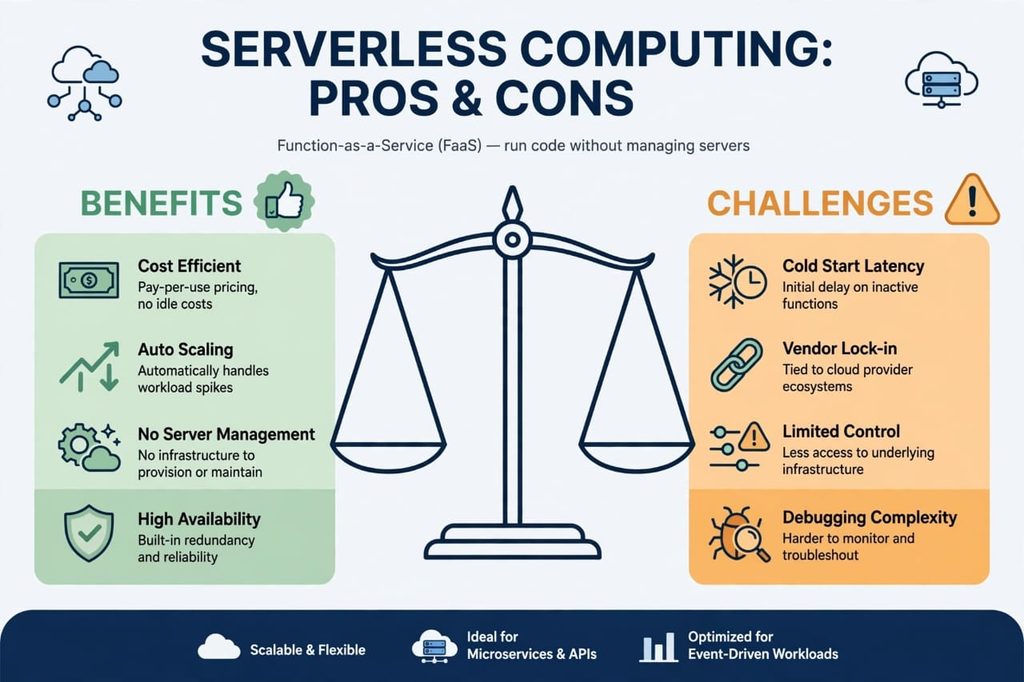
#1. You Save A Lot Of Money – Pay Only For What You Use
This is the number one benefit of serverless computing, and the reason most businesses start with it.
Traditional hosting is like paying rent for a full office even if you only use one desk. Serverless is like paying only for the chair you sit on, for the hours you sit.
With serverless pricing, you pay per execution and per millisecond of runtime. If your code runs 1,000 times a day for 200 milliseconds each, you pay for exactly that. No more, no less.
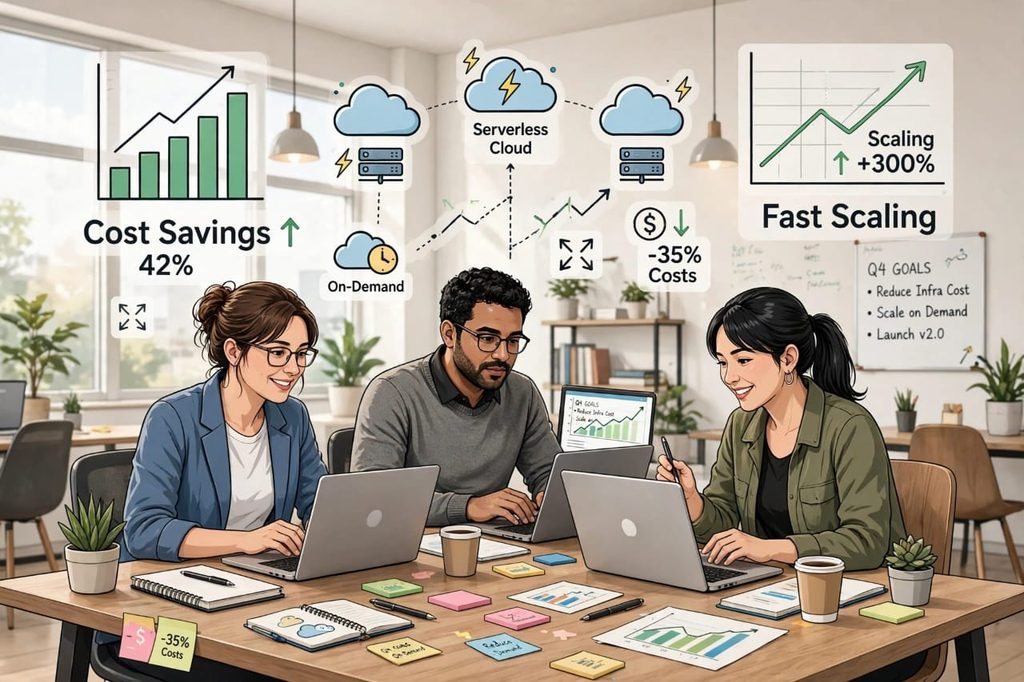
For startups and small businesses, this is huge. Many companies report 30% to 60% cost savings after moving to serverless. Some even save more because they no longer need a full DevOps team to manage servers.
Think about it. No server maintenance cost. No over-provisioning. No paying for idle time.
In 2026/27, where every dollar counts, this pay-as-you-go model makes serverless computing one of the smartest financial decisions for SaaS companies.
2. Automatic Scaling Without Any Stress
Scaling is the nightmare of every developer.
You launch a product. It goes viral on TikTok. Suddenly 100,000 people are on your website. Your server crashes. You lose customers, money, and reputation.
With serverless architecture, this problem almost disappears.
Serverless platforms automatically scale up and down. If 10 people use your app, it runs 10 functions. If 10,000 people use it, it runs 10,000 functions in parallel. You do not need to do anything. You do not need to buy new servers at 2 AM.
This automatic scaling is perfect for SaaS applications, e-commerce stores, mobile apps, and AI tools that have unpredictable traffic.
And the best part? When traffic goes down, it scales down automatically too. So you are never overpaying.
For growing businesses, this means you can handle success without fear. Your infrastructure will not stop your growth.
3. Developers Can Focus On Code, Not Servers
Ask any developer what they hate most, and many will say: “Managing servers.”
Updating operating systems, patching security issues, configuring load balancers, fixing crashes at midnight. It is boring, stressful, and takes time away from building real features.
Serverless removes all of that.
Your developers just write code. The cloud provider handles provisioning, maintenance, patching, and availability.
This means your team can launch new features faster. A new startup can go from idea to live product in days, not months. A small team of 2-3 developers can do the work that used to need 8-10 people.
In 2026/27, speed is everything. The companies that move fast, win. Serverless gives your team that speed.
This is also why serverless is so popular for building MVPs, prototypes, and AI agent platforms. You can test an idea quickly without investing in expensive infrastructure.
4. Faster Time To Market – Launch In Days, Not Months
In the old world, launching a new app meant weeks of planning. Buy servers, set up databases, configure networks, test everything.
With serverless computing, you can skip most of that.
You write a function, deploy it, and it is live. Services like AWS Lambda, Cloudflare Workers, and Vercel Functions let you deploy in minutes.
This is a massive advantage for SaaS startups. You can launch, get feedback from real users, fix problems, and launch again. This fast feedback loop is how successful companies are built today.
If you are a founder in 2026, you do not have time to waste on infrastructure. Your customers do not care about your servers. They care about your product. Serverless lets you focus 100% on your product..
5. Built-In High Availability And Reliability
What happens if a server crashes in a traditional setup? Your website goes down. Your customers get angry. You lose sales.
Cloud providers have solved this with serverless.
Serverless functions run across multiple data centers. If one fails, another takes over automatically. You get high availability and fault tolerance built-in, without doing anything extra.
For businesses that cannot afford downtime, like fintech, healthcare, and e-commerce, this reliability is priceless.
You also get automatic backups, monitoring, and security updates from providers like AWS and Google. That is enterprise-level reliability, even for a small business.
6. Perfect For Modern Workloads: AI, APIs, And Automation
Serverless is not just for websites. In 2026/27, it is becoming the backbone for modern workloads.
AI applications? Serverless is perfect for running AI models on-demand, processing images, and handling chatbot requests.
APIs and microservices? Each API endpoint can be a separate serverless function. Easy to manage, easy to update.
Workflow automation? When a new order comes in, a serverless function can automatically send an email, update your CRM, and create an invoice. No human needed.
Event-driven apps? File uploads, form submissions, IoT data, payment notifications – all of these are perfect for serverless.
That is why so many AI SaaS companies and automation tools in 2026 are built on serverless architecture. It fits perfectly with how modern software works.
The Honest Truth: Disadvantages Of Serverless Computing
Now, let’s be honest. As promised, serverless is not perfect. A good human guide must tell you both sides.
1. Cold Start Problem
If your function has not been used for a while, it can take 1-2 seconds to start. This is called a cold start. For most apps, users will not notice. But for real-time gaming or high-frequency trading, it can be a problem.
Good news: In 2026, providers have reduced cold starts a lot with provisioned concurrency and better runtimes.
2. Vendor Lock-In
If you build everything on AWS Lambda, moving to Google Cloud later is not easy. Your code becomes tied to one provider. This is a real risk, and smart companies plan for it by using portable frameworks.
3. Limited Control
You cannot control the underlying server. You cannot install custom software or tweak the operating system. For 95% of businesses, this is fine. But for very special use cases, you might need traditional servers.
4. Debugging Can Be Harder
When your code is split into 50 small functions, finding a bug can be tricky. You need good logging and monitoring tools like Datadog or AWS CloudWatch.
So, is serverless still worth it? For most businesses, yes. The benefits are much bigger than the disadvantages, especially if you start small.
Serverless vs Traditional Servers vs Containers: Which Is Better?
Let’s compare quickly so you can decide:
Traditional Servers: Full control, but high cost, slow scaling, lots of maintenance. Good for very large, stable workloads.
Containers (Docker / Kubernetes): More flexible, good for complex apps, but still need management and DevOps skills.
Serverless Computing: Lowest cost, fastest scaling, zero maintenance. Best for startups, SaaS, APIs, automation, and event-driven apps.
In 2026/27, most smart companies are not choosing just one. They use a hybrid approach. Core, stable services on containers, and fast-changing, event-driven features on serverless. That is the best of both worlds.
Best Serverless Platforms In 2026/27
If you are ready to try serverless, here are the top platforms:
- AWS Lambda – The most popular, biggest ecosystem, best for large projects. Part of Amazon Web Services.
- Google Cloud Functions – Great for AI and data processing, simple to use.
- Microsoft Azure Functions – Best if your company already uses Microsoft tools.
- Cloudflare Workers – Super fast, great for edge computing and global apps.
- Vercel Functions – Best for frontend developers and Next.js apps.
My honest advice for beginners: Start with AWS Lambda or Cloudflare Workers. Both have a generous free tier. You can experiment without spending money.
How To Get Started With Serverless – Step By Step
You do not need to be an expert to start. Follow these simple steps:
Step 1: Pick one small task. Do not migrate your whole company. Start with one feature, like sending welcome emails or processing image uploads.
Step 2: Choose a provider. If you are new, try AWS Lambda free tier.
Step 3: Write one function. Keep it small and simple. One function should do one job.
Step 4: Test and monitor. Use the provider’s dashboard to see cost, speed, and errors.
Step 5: Scale slowly. Once the first function works, move more features to serverless.
This slow, smart approach is how successful businesses migrate without risk.
Real Business Use Cases Of Serverless Computing
Let’s look at where serverless works best in real life:
E-commerce: Handle checkout, payment notifications, and inventory updates during sales spikes.
SaaS Startups: Build and launch MVPs quickly without hiring a DevOps team.
Media And Content: Automatically resize images, convert videos, and process uploads.
AI And Chatbots: Run AI models only when a user asks a question, saving huge costs.
Fintech: Process transactions, send alerts, and run fraud checks in real-time.
If your business has variable traffic, or you want to launch fast, serverless is likely a perfect fit.
Final Verdict: Should Your Business Move To Serverless In 2026/27?
So, should you move to serverless?
If you are a startup, a small business, a SaaS founder, or a developer who wants to launch fast and save money, then YES. Serverless computing is one of the best decisions you can make in 2026/27.
You will save money, scale automatically, launch faster, and your team will be happier because they can focus on building, not fixing servers.
If you are a very large enterprise with extremely stable, predictable workloads and need full control over hardware, then you might keep some services on traditional servers. But even then, you should use serverless for new features and experiments.
The world is moving to serverless. Not because it is trendy, but because it just makes business sense.
The companies that adapt early will have lower costs, faster products, and happier customers. The companies that wait will keep paying for idle servers.
Conclusion
The benefits of serverless computing are clear: lower cost, automatic scaling, faster development, higher reliability, and freedom from server management.
Yes, it has some challenges like cold starts and vendor lock-in. But for most businesses in 2026/27, those are small problems compared to the huge benefits.
If you have not tried serverless yet, now is the perfect time to start. Pick one small project, try AWS Lambda or Cloudflare Workers, and see the difference yourself.
Have you already moved to serverless? What was your experience? Share your story in the comments – we would love to hear it.
And if you want to publish your own SaaS or cloud computing guest post on this site, check our Write For Us page. We accept high-quality SaaS, AI, and cloud articles.
Frequently Asked Questions (FAQs)
What are the main benefits of serverless computing?
The main benefits are cost savings, automatic scaling, no server management, faster time to market, and high availability. You only pay for what you use.
Is serverless cheaper than traditional servers?
Yes, for most businesses it is cheaper, especially for apps with variable traffic. You do not pay for idle server time.
What is an example of serverless computing?
AWS Lambda, Google Cloud Functions, Azure Functions, and Cloudflare Workers are all examples. When you upload a photo and it gets automatically resized, that is often serverless.
Is serverless good for startups?
Yes, serverless is perfect for startups because it has low upfront cost, scales automatically, and lets small teams launch fast without a DevOps team.
What is the difference between serverless and cloud computing?
Cloud computing is the big category. Serverless is a type of cloud computing where you do not manage servers and you pay per function execution.