
If you are running a startup in the US in 2026, you already know one painful truth: attention is expensive.
Facebook Ads are getting more costly. Google Ads are getting more competitive. Social media algorithms change every few months. But email? Email is still yours.
When someone gives you their email address, they are not just scrolling past you. They are saying, “Okay, I trust you enough to hear from you again.” That is powerful. And for a US startup with a small budget, that trust is gold.
I have seen many founders make the same mistake. They spend $2,000 on ads before they even have an email list. Then they wonder why no one comes back. The smart founders do it the other way. They build an email list from day one, even if it is just 50 people. Then they grow it slowly, honestly, and consistently.
In this guide, I will walk you through the best email marketing tools for US startups in 2026/27, both free and paid. No hype. No sponsored ranking. Just real pros, real cons, and real advice on which one fits your stage.
By the end, you will know exactly which tool to start with, when to stay free, and when it is time to upgrade to paid.
Why Email Marketing Still Works for US Startups in 2026
Let me be honest with you. Email is not sexy. It is not TikTok. It will not make you viral overnight.
But here is what email does do:
- It gives you the highest ROI in marketing. For every $1 spent, many US businesses still see $36 to $42 back. That is crazy compared to paid ads.
- You own your list. Instagram can ban you. Google can drop your ranking. But your email list stays with you.
- It builds real relationships. A good welcome email feels personal. A good newsletter feels like a friend updating you, not a company selling to you.
- It works for every type of startup. SaaS, e-commerce, agency, coaching, newsletter, local business – all of them need email.
In 2026, the game has changed a little. US customers are smarter. They hate spam. They hate generic emails. They want personalization, short emails, and real value. The tools in this list have adapted to that. They now offer AI subject lines, automation, segmentation, and better deliverability for US inboxes like Gmail, Outlook, and Yahoo.
So, if you are still thinking, “Is email dead?” – No, my friend. Email is not dead. Bad email is dead.
How to Choose the Right Email Marketing Tool for Your Startup
Before we jump into the tools, let me save you from a common mistake: Do not pick the most popular tool. Pick the tool that fits your current stage.
Ask yourself these 5 questions:
- How many subscribers do you have right now? 0-500, 500-2,000, or 10,000+?
- What is your monthly budget? $0, $20, or $100+?
- Do you need automation? Just a simple newsletter, or a full welcome series, abandoned cart, and onboarding flow?
- Do you sell products? If you run a Shopify store, you need deep e-commerce integration.
- How tech-savvy are you? Some tools are drag-and-drop easy. Others need a little learning.
For most US startups, my simple rule is this: Start free. Learn the basics. Get your first 500 to 1,000 subscribers. Then move to paid only when free starts holding you back.
Now, let’s look at the best options.
1. Mailchimp – Best for Beginners Who Want to Start Free
Mailchimp is the name almost every founder hears first. And there is a good reason for that. It made email marketing easy for non-technical people.
If you are just starting your startup in the US and you have zero subscribers, Mailchimp is a very safe place to begin.
What I Like About Mailchimp
It has a clean drag-and-drop builder. You can create a beautiful email in 15 minutes without knowing any code. It has hundreds of templates for US audiences, from SaaS product launches to e-commerce sales. Its free plan lets you have up to 500 contacts and send 1,000 emails per month. That is more than enough for your first 2-3 months. It also connects easily with WordPress, Shopify, Canva, and many other tools US startups use daily.
What I Don’t Like About Mailchimp
The pricing jumps fast. Once you cross 500 contacts, you have to pay, and the price keeps increasing as your list grows. Some advanced automation features are locked behind higher plans. And many experienced marketers feel that its deliverability is not as strong as it was 5 years ago. Also, the free plan adds Mailchimp branding to your emails, which looks a little less professional.
Best for: US startups with 0-500 subscribers who want a free, easy, quick start.
Pricing: Free up to 500 contacts. Paid plans start around $13 per month.
Verdict: Great to start, but don’t be afraid to leave it when you outgrow it.
2. ConvertKit (Now Kit) – Best for Creators, Bloggers, and SaaS Founders
If your startup is content-driven – you have a blog, a newsletter, a YouTube channel, or you sell digital products – then ConvertKit, now called Kit, might be your best friend.
I personally love Kit for one reason: It feels human. It is built for creators, not for big corporations.
What I Like About Kit
Its automation is visual and simple. You can build a welcome sequence like: Someone signs up > Wait 1 day > Send value email > Wait 2 days > Send soft pitch. All with just a few clicks. Its landing pages and forms are excellent. You can create a signup form in 5 minutes and embed it on your SaaS site. Its deliverability in the US is very strong, especially for Gmail. And it does not count unsubscribes and duplicates in a confusing way.
What I Don’t Like About Kit
It is not the cheapest. Its free plan is good up to 1,000 subscribers, but after that, it gets expensive faster than some competitors. Its email templates are more simple and text-focused. If you want super fancy, image-heavy design emails like a fashion brand, Kit is not the best choice. It is built for simple, personal, high-converting emails.
Best for: SaaS founders, bloggers, newsletter writers, coaches, and creators in the US.
Pricing: Free up to 1,000 subscribers. Paid starts around $29 per month.
Verdict: If you want to build trust and sell through storytelling, Kit is worth every penny.
3. Brevo (Formerly Sendinblue) – Best Free Tool for Growing Startups
Brevo is the underdog that many US startups are now discovering in 2026. And honestly, it deserves more attention.
Why? Because its pricing is based on emails sent, not on number of contacts. That is a huge advantage.
What I Like About Brevo
Its free plan allows up to 300 emails per day. That is perfect for a small startup. You can have unlimited contacts even on the free plan. Yes, unlimited. You can also send SMS and WhatsApp campaigns from the same dashboard, which is great if you target US customers on multiple channels. It has good automation, transactional emails, and CRM features built-in. For a startup that wants everything in one place, Brevo is very powerful.
What I Don’t Like About Brevo
The interface can feel a little overwhelming at first. It has so many features that a complete beginner might feel lost for the first few days. Its email template designs are good, but not as polished as Mailchimp. And its customer support on the free plan is slower.
Best for: US startups that are growing fast and want unlimited contacts on a free plan.
Pricing: Free up to 300 emails/day. Paid starts around $25 per month for 20,000 emails.
Verdict: Best value for money if you have a large list but send fewer emails.
4. ActiveCampaign – Best Paid Tool for Serious Automation
Now let’s talk about the serious player. If your startup is already making money and you want to automate everything, ActiveCampaign is the king.
This is not a beginner tool. This is for startups that are ready to scale.
What I Like About ActiveCampaign
Its automation is on another level. You can create advanced flows like: If a user visits your pricing page 3 times but does not buy > Send them a personalized email > If they open it, add a tag > If they click, notify your sales team. It has a built-in CRM, lead scoring, and deep segmentation. That means you can send the right email to the right person at the right time. For SaaS startups in the US, this is a game-changer. It also integrates with over 900 apps.
What I Don’t Like About ActiveCampaign
It is expensive for a brand-new startup. Plans start around $39 per month, and they go up quickly. It has a learning curve. You will need 2-3 days to really understand it. And if you just want to send a simple weekly newsletter, this tool is overkill. It is like buying a Ferrari to go to the grocery store.
Best for: SaaS, agencies, and e-commerce startups in the US doing $10k+ per month and ready to automate sales.
Pricing: Starts around $39 per month.
Verdict: Powerful, but only upgrade to this when you actually need the power.
5. Klaviyo – Best for US E-commerce Startups
If you run a Shopify, WooCommerce, or any e-commerce startup in the US, stop reading other tools for a second. Klaviyo was made for you.
I have seen e-commerce brands double their revenue just by setting up Klaviyo flows properly. It is that good for online stores.
What I Like About Klaviyo
Its integration with Shopify is flawless. It automatically pulls your product data, customer behavior, and purchase history. Its pre-built flows are amazing: Abandoned cart, browse abandonment, post-purchase thank you, win-back, and VIP flows. You can set them up in one day. Its segmentation is super detailed. You can send an email only to people who bought shoes in the last 30 days and live in California. That level of targeting sells.
What I Don’t Like About Klaviyo
It is pricey. Its free plan only allows 250 contacts. After that, pricing grows fast, especially for large lists. It is not ideal for non-e-commerce businesses. If you run a SaaS or a blog, you will not use 70% of its features. And it can be addictive – you might end up sending too many emails if you are not careful.
Best for: US e-commerce startups, Shopify stores, DTC brands.
Pricing: Free up to 250 contacts. Paid starts around $20 per month and scales with list size.
Verdict: If you sell products online, Klaviyo will pay for itself.
6. MailerLite – Best Budget-Friendly Tool for US Startups
MailerLite is my favorite hidden gem for startups that want beauty + simplicity + low price.
It is like the younger, cheaper, friendlier brother of Mailchimp.
What I Like About MailerLite
Its free plan is generous: Up to 1,000 subscribers and 12,000 emails per month. That is excellent. Its editor is very clean and easy. Its landing pages and signup forms look modern and professional. It has good automation even on the free plan, which most tools do not offer. And its paid plans are very affordable for US startups.
What I Don’t Like About MailerLite
Its integrations are fewer than Mailchimp or ActiveCampaign. Its deliverability is good, but not the absolute best in the industry. And its customer support can be slow during peak times. Also, its approval process for new accounts can sometimes take a day or two, which can be annoying when you want to start immediately.
Best for: US startups that want a beautiful, simple, and affordable tool.
Pricing: Free up to 1,000 subscribers. Paid starts around $10 per month.
Verdict: If you are on a tight budget but still want a professional look, start with MailerLite.
Free vs Paid: When Should a US Startup Upgrade?
This is the question every founder asks me. “Should I stay free or pay?”
Here is my honest answer, from real experience:
Stay on FREE if:
- You have less than 1,000 subscribers
- You send less than 2-3 emails per week
- You just need basic newsletters and welcome emails
- You are still testing your idea and you have no revenue yet
Upgrade to PAID when:
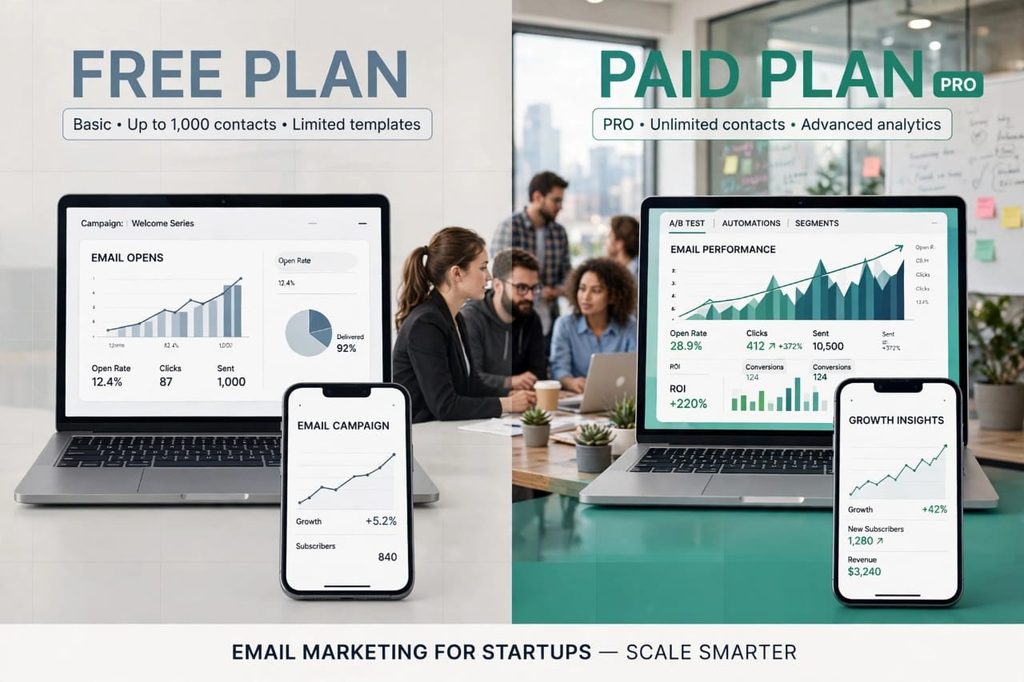
- You cross 1,000 subscribers and free limits start blocking you
- You need automation like abandoned cart, onboarding series, or sales funnels
- You want to remove branding like “Sent by Mailchimp” from your emails
- You want A/B testing to improve your open rates
- You are making money from email and you want to scale it
Remember: Paid does not mean better. Paid means more features. If you are not using those features, you are just wasting money. I have seen founders pay $99 per month for a tool they use like a $0 tool. Don’t be that founder.
Real Example: How a Small US SaaS Startup Grew with Email
Let me tell you a quick story. It is not a theory. This is how many small US startups actually do it.
A founder in Texas started a small SaaS tool for remote teams. He had zero audience. He started with MailerLite free plan. He created one simple lead magnet: “Free Checklist: 10 Tools for Remote Teams.”
He put the form on his blog. In the first month, he got 87 subscribers. Not huge, right?
But he sent them one valuable email every week. No spam. No hard selling. Just helpful tips.
By month 3, he had 620 subscribers. By month 6, he had 1,800 subscribers. At that point, he moved to ConvertKit paid plan because he needed better automation.
By month 9, he launched his paid SaaS plan to his list first. 42 people bought on day one. Not from ads. From email.
That is the power of email. It is slow in the beginning, but it compounds.
Pros and Cons of Email Marketing for US Startups – Honest Talk
Let’s be fair. Email marketing is not perfect. I want you to know both sides.
Pros:
- Low cost to start, you can literally start for $0
- Very high ROI compared to ads
- You own your audience, no algorithm can take it away
- Great for building trust and long-term customers
- Works on autopilot with automation
- Easy to measure: open rate, click rate, sales
Cons:
- It takes time to build a list, it is not instant
- US spam laws like CAN-SPAM require you to follow rules, you must include unsubscribe link
- If you send too many emails, people will unsubscribe or mark you as spam
- Your open rates will drop if your subject lines are boring
- You need to keep your list clean, remove inactive subscribers
The key is balance. Send value first, sell second. If you follow that, the cons become very small.
Best Practices for US Startups in 2026/27
If you want your emails to actually land in the inbox and get opened in the US, follow these 7 rules:
- Use a professional domain email. Don’t send from gmail.com. Send from hello@yourstartup.com. It builds trust and improves deliverability.
- Write short subject lines. 40-50 characters work best. Be curious, not clickbait.
- Personalize. Use the person’s first name. Segment your list. A generic email to everyone performs worse than a personal email to 100 people.
- Be consistent. Pick one day per week and stick to it. Your subscribers will start waiting for your email.
- Always add value. Every email should teach, help, or entertain. If you only sell, people will leave.
- Clean your list every 3 months. Remove people who never open. A small active list is better than a big dead list.
- Follow US laws. Always include your business address and an unsubscribe link. It is not just legal, it is respectful.
Final Verdict: Which Tool Should You Pick in 2026/27?
If you are confused, here is my simple recommendation:
- Just starting and have $0 budget? Start with MailerLite or Brevo Free.
- You are a creator, blogger, or SaaS founder? Go with Kit (ConvertKit).
- You run an e-commerce store in the US? Go with Klaviyo.
- You are already making money and want full automation? Go with ActiveCampaign.
- You want the easiest beginner experience? Go with Mailchimp.
There is no perfect tool. There is only the right tool for your current stage. Pick one, start today, and don’t keep switching every week. The best tool is the one you actually use consistently.
Conclusion
Email marketing in 2026/27 is not about sending more emails. It is about sending better emails to the right people.
US startups that win in 2026 will not be the ones with the biggest ad budget. They will be the ones with the strongest relationship with their audience. And that relationship is built in the inbox.
So, pick your tool from this list. Create your first form today. Get your first 10 subscribers this week. Then 100. Then 1,000.
Your future customers are waiting in your inbox. Go and meet them.
Which tool are you using right now? Let me know in the comments. And if this guide helped you, share it with another US founder who is still confused.
Frequently Asked Questions (FAQs)
What is the best free email marketing tool for US startups in 2026?
MailerLite and Brevo are the best free options. MailerLite gives you up to 1,000 subscribers free, while Brevo gives you unlimited contacts with 300 emails per day.
How much does email marketing cost for a US startup?
You can start for $0. Most startups spend $0-$29 per month in the beginning. Once you cross 5,000 subscribers, expect to pay $50-$100 per month depending on the tool.
Which email marketing tool is best for SaaS startups in the US?
Kit (ConvertKit) and ActiveCampaign are best for SaaS. Kit is great for simple automation and newsletters. ActiveCampaign is best for advanced sales automation and CRM.
Is Klaviyo worth it for small e-commerce startups?
Yes, if you run a Shopify store. Its abandoned cart and post-purchase flows alone can recover 10-20% of lost sales, which easily covers its cost.
When should I switch from free to paid email marketing?
Switch when you hit 1,000 subscribers, when you need automation, or when you want to remove branding and use A/B testing. Don’t upgrade just because you feel like you should.
How many emails should a US startup send per week?
For most startups, 1 to 2 emails per week is perfect. If you send daily, you need to give massive value, otherwise people will unsubscribe fast.
Is email marketing still effective in 2026/27?
Yes, 100%. Email still gives the highest ROI of all marketing channels. The key is personalization and value, not spam.
[…] the third reason is impatience. SaaS marketing in the US is not a sprint. It is a marathon. Many founders run ads for 7 days, get no sales, and […]
[…] 4: You Pay A SubscriptionMost SaaS tools work on a SaaS pricing model. You pay monthly or yearly. For example, $9 per month for Basic, $19 […]