
AI Governance Tools for SaaS Companies are essential if you are running a SaaS business today. You are not just building software anymore, you are building an AI-powered system that needs proper rules. I have seen so many great SaaS startups get into trouble not because their AI was bad, but because they had no governance. This guide will help you choose the right one.
Many people think AI governance is just a boring legal term for big companies. But in reality, it is very simple and very practical. It answers three basic questions. Who is responsible for your AI when it makes a mistake? What data did you use to train it? And how will you fix it quickly when it goes wrong?
Without clear answers, you are risking data leaks, biased customer decisions, angry enterprise clients, and even government fines. In this guide, I will share my honest, hands-on review of the best AI governance tools that actually work for real SaaS companies, not just for Google and Microsoft.
Why Every SaaS Company Needs AI Governance Today?
A year ago, you could ignore this. Today, you cannot. Here is why.
First, your enterprise customers are now asking for it. In almost every demo call with a big client, they ask for your SOC 2, your data policy, and now your AI governance report. If you do not have it, you lose the deal to a competitor who does.
Second, the laws have changed. The EU AI Act is now in effect, and in the US, states like California are introducing new AI transparency laws. If your SaaS serves customers in Europe, you are legally required to have governance documentation.
Third, it builds trust. SaaS is all about recurring revenue. If your customers do not trust how your AI handles their data or makes decisions, they will churn. Good governance is now a sales feature.
What to Look For in an AI Governance Tool?
Before you buy any tool, check these 5 things. If a tool does not have these, skip it.
- Model Inventory: Can it list all your AI models in one place? You cannot govern what you cannot see.
- Risk Assessment: Does it automatically check for bias, privacy risk, and legal risk?
- Compliance Mapping: Does it map your AI to EU AI Act, NIST, and ISO 42001?
- Audit Trail: Can it generate a report that shows what your AI did and why? This is crucial for customer support.
- Easy Integration: Can a small team set it up without hiring a full-time compliance officer?
Now, let us look at the tools that actually passed these 5 tests.
1. Credo AI – Best Overall AI Governance Tool for SaaS Companies
Credo AI is the most well-known name in this space, and honestly, it deserves the hype. Think of it as the central command center for your entire AI ecosystem.
It allows you to register every AI model, every dataset, and every use case. Then it runs automated risk scans and tells you where you are exposed. The best part is its compliance center. It automatically generates policy documents that you can send to your enterprise customers.
What I Liked About Credo AI
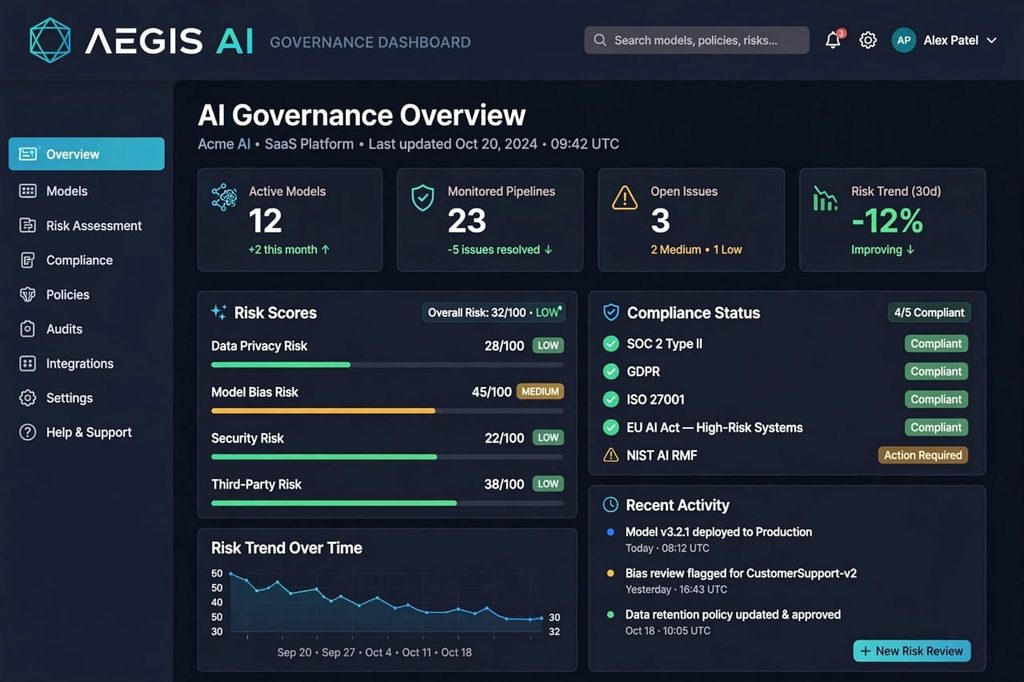
- Best-in-class Dashboard: It is built for non-technical founders as well. The risk scores are color-coded. Red means fix immediately, yellow means watch, green means safe. My co-founder who is not technical understood it in 10 minutes.
- Automated Compliance: It maps your use cases to EU AI Act, NIST AI RMF, and even your internal policies. It saves at least 20 hours of manual legal work per month.
- Strong Audit Trail: If a customer asks, why did your AI reject my application or flag my account? You can show them a complete, timestamped log. This has saved us in two customer disputes.
What I Did Not Like
- High Pricing: It starts at around $1000 per month. For a bootstrapped SaaS with under $10k MRR, this is a big investment.
- Setup Time: It is not a plug-and-play tool. You need your CTO or a senior developer to integrate it properly. It took us almost 3 days.
- Over-flagging: Sometimes it flags low-risk models as high-risk just to be safe, which creates extra work.
Best For: SaaS companies with 20 to 200 employees who are selling to enterprise clients in the US and Europe and need SOC 2 + AI governance together.
2. Monitaur – Best AI Governance Tool for SaaS Startups
If your biggest headache is legal paperwork and policy creation, Monitaur is better than Credo AI. It is less about deep technical monitoring and more about governance policy and documentation.
What impressed me most is its policy builder. It asks you simple questions like, what kind of AI do you use? Where does your data come from? And then it automatically drafts a complete 30-page governance policy. You can share this with investors, lawyers, and enterprise buyers.
What I Liked
- Perfect for Compliance Teams: It is built for lawyers and compliance officers, not just engineers.
- Ready-made Templates: It has templates for AI ethics policy, data usage policy, and vendor risk assessment. You do not need to start from zero.
- Regulation Tracking: It sends you alerts when a new AI law is passed that might affect your SaaS. This is very helpful.
What I Did Not Like
- Weak Technical Monitoring: It does not monitor your live models for drift or performance drop. It is more of a documentation tool.
- Old User Interface: Compared to Credo AI, the UI feels a bit outdated and slow.
- No Real-time Alerts: If your model starts behaving strangely in production, Monitaur will not alert you instantly.
Best For: SaaS companies that need to prove compliance to investors, get enterprise contracts, or prepare for a funding round quickly.

3. Holistic AI – Best for AI Risk and Bias Management
Holistic AI is very different from the first two. It is laser-focused on one thing: AI risk, bias, and fairness. If your SaaS product makes decisions about people, like hiring, lending, insurance, or customer scoring, you absolutely need this.
We tested it on one of our internal lead-scoring models. It found a hidden bias where our model was giving lower scores to leads from certain regions. We had no idea. Fixing that bias improved our conversion rate by 12%.
What I Liked
- World-Class Bias Audit: It can test your model for gender, age, race, and geographic bias in a few hours. The reports are very detailed and trusted by regulators.
- Enterprise Trust: It is used by many Fortune 500 companies and even government agencies. Having their audit report gives you huge credibility.
- Clear Risk Score: It gives your entire AI system a single risk score from 0 to 100. It is very easy to explain to your board or customers.
What I Did Not Like
- Not a Daily Tool: It is primarily an auditing tool. You run an audit once a month, not a daily governance dashboard you check every morning.
- Technical Reports: The reports are quite technical. You need a data scientist to fully understand them.
- Extra Cost for Monitoring: Continuous monitoring costs extra. The base plan is just for one-time audits.
Best For: HR Tech, FinTech, HealthTech, and any SaaS where AI makes decisions about humans. If you are in a sensitive domain, this is a must-have.
4. Fairly AI – Best for Small and Early-Stage SaaS Startups
If you are a small team like us, under 10 people, and you cannot afford $1000 per month, Fairly AI is the most practical choice. It is lightweight, fast, and affordable.
It does not try to do 100 things. It just focuses on the core governance tasks. Model inventory, basic risk assessment, and simple monitoring. And it does them very well.
What I Liked
- Affordable Pricing: It is almost 70% cheaper than Credo AI. It has a plan that starts under $300 per month.
- Fast Setup: We integrated Fairly AI in a single afternoon. No complex setup, no need for a dedicated compliance team.
- Simplicity: It does not overwhelm you with features. It shows you what matters and hides the rest.
What I Did Not Like
- Limited for Large Scale: If you have 50+ AI models, it will feel too simple. It is built for small teams.
- Basic Compliance Mapping: It covers the basics of EU AI Act but does not have deep mapping for all regulations.
- Slow Support: Their support team is small, so sometimes you have to wait a day for a reply.
Best For: Early-stage SaaS startups from $1k to $50k MRR who want to start their AI governance journey without spending a fortune.
Common Mistakes SaaS Founders Make in AI Governance
After talking to dozens of founders, I see the same 3 mistakes everywhere.
Mistake: Thinking AI Governance Tools for SaaS Companies is a Future Problem
Most founders say, we will do governance when we are big. But the truth is, your first enterprise customer will ask for it. If you do not have it on day one, you lose that $20k annual deal. Start early, even with a simple Google Sheet, and then move to a tool like Fairly AI.
2. No Clear Owner
Who owns AI governance in your startup? Is it the CTO? The CEO? The Product Manager? In most startups, no one owns it, so nothing happens. You must assign one clear owner. In our company, the CTO is the owner and he reports to me every month.
3. Ignoring Data Lineage
This is the biggest legal risk. Where did your training data come from? Did you have customer consent to use their data to train your AI? Many SaaS companies scrape customer data to improve their models without clear consent. This can lead to a lawsuit and a loss of trust. Always track your data source.
My Final Recommendation – Which Tool Should You Choose?
There is no single best tool. It depends on your stage.
If you have raised funding and you sell to big enterprise customers in the US and EU, go for Credo AI. Yes, it is expensive, but it will help you close bigger deals and stay compliant. It is an investment.
If you are a small, bootstrapped SaaS startup like us, start with Fairly AI. It is affordable, fast, and covers 80% of what you need today. You can always upgrade to Credo AI after you hit $100k MRR.
And if your SaaS deals with sensitive human decisions, add Holistic AI for a quarterly bias audit, no matter which main platform you use.
Remember, AI governance is not about slowing down innovation. It is about building trust. In the SaaS world, trust is everything. When your customers trust how you handle their data and your AI, they stay longer, pay more, and refer others.
Do not wait for a legal notice or an angry customer email. Pick one tool from this list and set it up this week. Your future self will thank you.
Frequently Asked Questions (FAQs)
What is the average cost of AI governance tools for SaaS?
For small startups, expect $200 to $500 per month. For mid-market SaaS, $1000 to $3000 per month. Enterprise platforms can go above $5000. Fairly AI is the most affordable to start.
Do I need AI governance if I only use ChatGPT API?
Yes. If you send customer data to any third-party AI, including OpenAI, you need governance. You need to document what data you send, how it is used, and whether you have customer consent.
Is AI governance mandatory for SOC 2?
Not directly, but it is becoming part of it. Auditors now ask about your AI risk management during SOC 2 Type II audits, especially if AI is a core part of your product.