
Best Crypto Wallets 2026 are the most important decision for any US investor. If you are investing in crypto in the United States in 2026, there is one decision that matters more than which coin you buy. It is where you store it.
I have seen too many smart people make money in crypto and then lose it in one night. Not because the market crashed. Not because they picked the wrong coin. But because they left their crypto on an exchange, clicked a fake link, or used a wallet that was not secure enough.
Let me be honest with you. Crypto is powerful because you can truly own your money. No bank can freeze it. No one can tell you what to do with it. But that freedom comes with responsibility. If you lose your keys, no customer support in the world can bring your money back.
That is why choosing the right crypto wallet is not a small technical detail. It is the foundation of your entire crypto journey.
In this guide, I will walk you through the 7 safest crypto wallets for US investors in 2026/27. I have kept it simple, honest, and practical. I will tell you what is great about each wallet, and also what is not so great. No hype. No sponsored nonsense. Just what you actually need to know before you trust a wallet with your hard-earned money.
What Is a Crypto Wallet, Really?
A lot of beginners think a crypto wallet actually holds coins inside it like a leather wallet holds cash. That is not how it works.
A crypto wallet actually stores your private keys. Those keys are like the password that proves you own your crypto on the blockchain. Your coins always live on the blockchain. The wallet is just the safe and secure tool that lets you access them, send them, and receive them.
If someone gets your private keys, they get your crypto. If you lose your private keys and your recovery phrase, you lose your crypto forever. It is that simple, and that serious.
That is why in 2026, with hackers getting smarter and phishing scams getting more realistic, you cannot just pick the first wallet you see on YouTube.
You need a wallet that fits your style: Are you a beginner? Are you holding for 5 years? Are you trading every day? Do you own Bitcoin only, or also Ethereum, Solana, and NFTs?
Let us break it down.
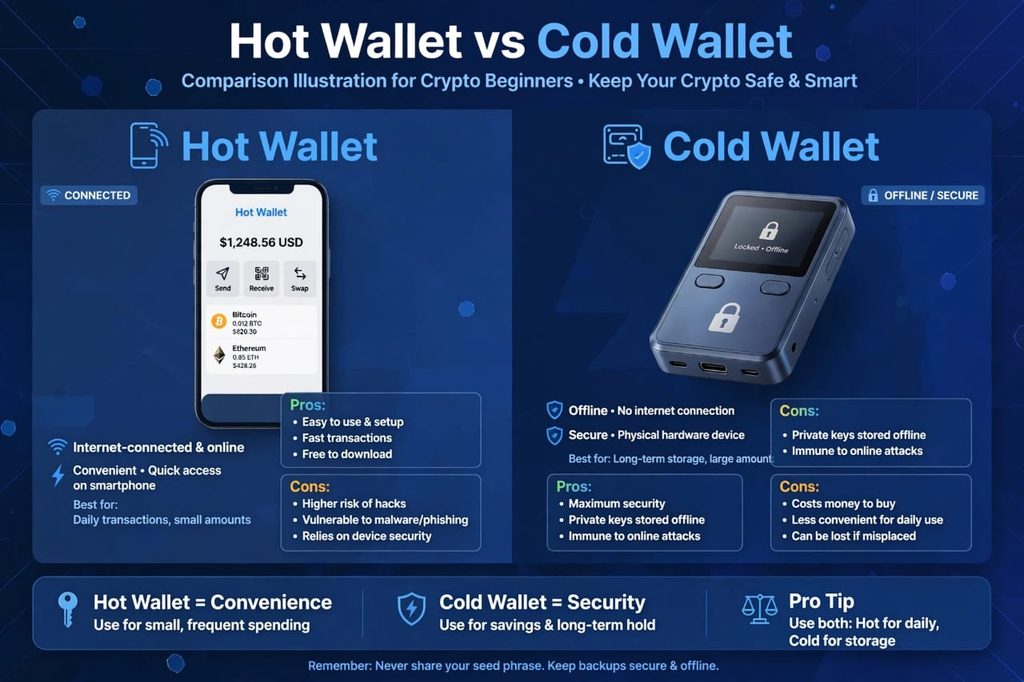
Hot Wallet vs Cold Wallet: The Most Important Difference
Before we look at the list, you must understand this one concept. It will save you from 90% of mistakes.
What is a Hot Wallet?
A hot wallet is connected to the internet. It can be a mobile app, a browser extension, or a desktop app.
Pros of Hot Wallet:
- Very easy to use, perfect for beginners
- Free to download and set up in 5 minutes
- Great for daily trading, sending, and swapping
- You can access it from anywhere
Cons of Hot Wallet:
- Because it is online, it is more vulnerable to hacks, malware, and phishing
- If your phone or computer gets hacked, your wallet is at risk
- Not ideal for storing a very large amount for a long time
Think of a hot wallet like the cash in your pocket. Convenient for daily use, but you would not walk around with your entire life savings in your pocket.
What is a Cold Wallet?
A cold wallet is offline. It is usually a small physical device, like a USB stick. Your private keys never touch the internet.
Pros of Cold Wallet:
- Maximum security, almost impossible to hack remotely
- Best for long-term holding and large amounts
- You have full control, no third party involved
Cons of Cold Wallet:
- Costs money, usually $70 to $250
- Less convenient for daily trading, you have to connect it each time
- If you lose the device AND your recovery phrase, you lose everything
Think of a cold wallet like a bank vault or a safe at home. Less convenient, but much safer for big savings.
My Honest Advice: Most smart US investors in 2026 use BOTH. A hot wallet for small, daily amounts, and a cold wallet for long-term savings. That is the safest strategy.
How to Choose the Right Wallet in 2026/27
Do not just follow hype. Ask yourself these 5 questions before choosing:
1. Security: Does it give you full control of your private keys? Does it support 2FA, biometric lock, and open-source code? Never use a wallet that holds your keys for you without telling you clearly.
2. Coins Supported: Do you only need Bitcoin? Or do you need Ethereum, Solana, Polygon, USDT, and NFTs too? Some wallets support 5,000+ coins, some support only a few.
3. Ease of Use: If you are a beginner, a complicated wallet will frustrate you. You need a clean interface, clear backup steps, and good US-based customer support.
4. Fees: Wallets themselves are often free, but swapping and network fees can be high. Check the fees before you commit.
5. US Compliance and Reputation: In 2026, US regulations are getting stricter. Choose a wallet from a reputable US-friendly company with a long track record, not a random new app from an unknown team.
Now, let us get to the main list.
The 7 Safest Crypto Wallets for US Investors in 2026/27
1. Ledger Nano X – Best Overall Hardware Wallet
If you ask any serious crypto investor in the US what they use for long-term storage, most will say Ledger.
Ledger Nano X is a Bluetooth-enabled hardware wallet. It supports over 5,500 coins and tokens, including Bitcoin, Ethereum, Solana, and many more.
Why US Investors Love It:
- Your private keys stay offline, completely safe from online hackers
- You can manage it easily with the Ledger Live app on your phone
- It has a secure chip, the same kind used in passports and credit cards
- Great for staking, so you can earn rewards while holding
The Negative Side:
- It costs around $149, so it is not free
- For a total beginner, the first setup can feel a little technical, takes about 15-20 minutes
- Bluetooth is convenient, but some ultra-paranoid users prefer a wired-only device
Best For: Anyone holding more than $1,000 in crypto and planning to hold for months or years.
2. Trezor Model T – Best for Maximum Security and Privacy
Trezor was actually the first hardware wallet ever made. The Model T is their premium version with a touchscreen.
Why US Investors Love It:
- Fully open-source software, which means anyone can check the code for hidden problems. This builds huge trust.
- Touchscreen makes it very easy to confirm transactions
- Strong privacy features, no KYC required to use the device itself
- Excellent reputation since 2014, never had a major remote hack
The Negative Side:
- It is expensive, around $219
- It does not support as many coins as Ledger, especially some newer Solana tokens
- It is a bit bulkier than Ledger
Best For: Privacy-focused investors and long-term Bitcoin and Ethereum holders who want the highest trust.
3. Exodus – Best Wallet for Beginners
If you are completely new and you feel scared of crypto, start with Exodus. It is beautiful, simple, and friendly.
Exodus is a hot wallet available on mobile and desktop. It supports 300+ cryptocurrencies.
Why US Investors Love It:
- The design is so clean, even your grandmother could use it
- Built-in swap feature, you can exchange coins inside the app without going to an exchange
- Great customer support, real humans reply 24/7
- You control your keys, and it works great with Trezor for extra security
The Negative Side:
- Because it is a hot wallet, it is not as secure as a cold wallet for very large amounts
- It is not fully open-source, which some advanced users do not like
- Swap fees inside the app can be higher than on a big exchange
Best For: Beginners who want to learn crypto without feeling confused.
4. Coinbase Wallet – Best for US Beginners Who Use Coinbase
Do not confuse this with the Coinbase Exchange app. Coinbase Wallet is a separate, self-custody wallet. That means YOU control your keys, not Coinbase.
Why US Investors Love It:
- Made by a US publicly traded company, so it feels trustworthy for Americans
- Very easy to connect to Coinbase Exchange, DeFi apps, and NFTs
- Supports a huge number of Ethereum tokens and NFTs
- Good security features including biometric lock and cloud backup
The Negative Side:
- Cloud backup is convenient, but if your cloud account is hacked, it can be a risk. Always use a strong password.
- It is heavily focused on Ethereum ecosystem. For Bitcoin-only users, there are better options.
- Some advanced users feel it is less private because it is connected to a big US company
Best For: US investors who already use Coinbase and want an easy, trusted way to explore Web3, NFTs, and DeFi.
5. MetaMask – Best for Ethereum, DeFi, and NFTs
If you want to use DeFi, buy NFTs, or explore Web3 websites, MetaMask is almost mandatory in 2026.
It is a browser extension and mobile app, used by over 30 million people worldwide.
Why US Investors Love It:
- It connects to almost every DeFi app and NFT marketplace
- You have full control of your keys
- Huge community, so you can find a tutorial for almost anything
- Free and easy to set up in 2 minutes
The Negative Side:
- This is the most targeted wallet by scammers. Fake MetaMask websites and phishing emails are everywhere.
- It is a hot wallet, so you should never store your life savings in it
- The interface can be confusing for beginners when it comes to gas fees and networks
Best For: Active users who want to use DeFi, NFTs, and Web3 apps, not just hold crypto.
6. Trust Wallet – Best Free Mobile Wallet
Trust Wallet is owned by Binance, and it is one of the most downloaded crypto wallets in the world. It supports 70+ blockchains and 10 million+ assets.
Why US Investors Love It:
- Completely free, super fast, and very easy to use
- Supports almost every coin you can think of, including Solana, BNB, and many small tokens
- Built-in staking, you can earn rewards on many coins
- Built-in Web3 browser to explore dApps
The Negative Side:
- Because it is hot and mobile-only, it is not ideal for storing a huge amount long-term
- Customer support is not as personal as Exodus or Ledger
- Being connected to Binance can worry some US users who prefer a fully US-based product
Best For: Mobile-first users who want one free app for many different coins.
7. Tangem Wallet – Best Modern, Card-Style Cold Wallet
Tangem is the new star of 2026. It does not look like a normal wallet. It looks like a credit card.
You just tap the card to your phone with NFC to send crypto. No cables, no battery, no screen.
Why US Investors Love It:
- Extremely simple. No charging, no cables, no complicated setup. Perfect for beginners who hate tech.
- Your keys are stored inside the secure chip in the card, offline
- You get 2 or 3 cards in a pack, so you have a backup if you lose one
- Very affordable compared to other hardware wallets, around $54 for 2 cards
The Negative Side:
- No screen on the card itself, so you have to trust your phone screen to verify transactions
- Newer company compared to Ledger and Trezor, so less long-term history
- If you lose all your cards AND your backup, you are in trouble, same as other cold wallets
Best For: Beginners and gift-givers who want cold wallet security without the technical headache.
Quick Comparison Table
| Wallet | Type | Price | Best For | Security Level |
|---|---|---|---|---|
| Ledger Nano X | Cold / Hardware | ~$149 | Overall Best | Very High |
| Trezor Model T | Cold / Hardware | ~$219 | Privacy & Security | Very High |
| Exodus | Hot / Software | Free | Beginners | Medium-High |
| Coinbase Wallet | Hot / Software | Free | Coinbase Users | Medium-High |
| MetaMask | Hot / Software | Free | DeFi & NFTs | Medium |
| Trust Wallet | Hot / Mobile | Free | Multi-Coin Mobile | Medium |
| Tangem Wallet | Cold / Card | ~$54 | Simple Cold Storage | High |
The 5 Security Mistakes That Cost US Investors Millions
Please read this part twice. A good wallet will not save you if you make these mistakes.
1. Never Share Your Seed Phrase: Your 12 or 24-word recovery phrase is your master key. No real company will ever ask you for it. Not Ledger, not Coinbase, not MetaMask. If someone asks, it is a scam. 100%.
2. Never Store Your Seed Phrase Online: Do not save it in Google Drive, iCloud, Gmail, or a screenshot. Hackers love to search cloud storage. Write it on paper and keep it in two safe, offline places.
3. Always Buy Hardware Wallets From The Official Website: Never buy Ledger or Trezor from Amazon, eBay, or Facebook Marketplace. Scammers sell tampered devices. Always buy direct.
4. Beware of Fake Apps: In 2026, fake wallet apps are on the App Store and Google Play. Always check the developer name, downloads, and official website link before downloading.
5. Do Not Keep Everything on an Exchange: Exchanges get hacked, go bankrupt, or freeze accounts. Remember the rule: Not your keys, not your coins. Move your long-term holdings to your own wallet.
What Should a Beginner in the US Actually Do?
If you are feeling overwhelmed, here is my simple, honest plan:
Step 1: If you are just starting with $100 to $500, download Exodus or Coinbase Wallet. Learn how to send, receive, and back up your seed phrase safely.
Step 2: Once your portfolio grows past $1,000, buy a Ledger Nano X or Tangem. Move your long-term holdings there. Keep only a small amount in your hot wallet for daily use.
Step 3: Write down your seed phrase, store it offline, and tell one trusted family member where it is in case of an emergency.
That is it. You do not need 10 wallets. You need one good hot wallet and one good cold wallet.
FAQs About Crypto Wallets in the US
Q1. Is it legal to use a crypto wallet in the US?
Yes, it is 100% legal. In the US, you can own and use a self-custody wallet. You still need to pay taxes on your crypto gains, but owning a wallet itself is legal.
Q2. Which is the safest crypto wallet for beginners in 2026?
For beginners, Exodus is easiest. For maximum safety, Ledger Nano X is the best balance of security and ease of use.
Q3. Can I lose my crypto if I lose my wallet device?
No, if you have your seed phrase. You can buy a new device and restore everything with your seed phrase. If you lose BOTH the device and the seed phrase, then yes, your crypto is lost forever.
Q4. Hot wallet or cold wallet – which is better?
Both have a purpose. Hot wallet is better for convenience and daily use. Cold wallet is better for security and long-term holding. Smart investors use both.
Q5. How much should I keep in a hot wallet?
A good rule is the 90/10 rule. Keep 90% in cold storage, and only 10% in a hot wallet for trading and daily use. Never keep your entire savings in a hot wallet.
Final Verdict: Which Wallet Should You Choose in 2026/27?
There is no one perfect wallet for everyone. It depends on you.
- If you want the best overall security and plan to hold long-term, go with Ledger Nano X.
- If you want maximum privacy and trust, go with Trezor Model T.
- If you are a total beginner and want something easy, start with Exodus.
- If you live in the Coinbase ecosystem, Coinbase Wallet will feel like home.
- If you love DeFi and NFTs, you need MetaMask.
- If you want a free, all-in-one mobile wallet, Trust Wallet is hard to beat.
- If you want cold wallet security without the tech stress, try Tangem.
My personal honest take? Do not overthink it. Pick one wallet from this list today, set it up correctly, back up your seed phrase offline, and start small. Security is a habit, not a product.
Crypto is still early in 2026. The people who win in the long run are not the ones who chase every new coin. They are the ones who protect what they already have.
Choose wisely, stay safe, and never share your seed phrase.
Disclaimer: This article is for educational purposes only and is not financial advice. Crypto is volatile and risky. Always do your own research and consider talking to a licensed financial advisor in the US before investing.
Also Read: Real-World Asset (RWA) Tokenization: The Biggest Crypto Trend Transforming Finance in 2026