
Best SDR software defined radio for beginners in 2026 is the easiest way to start listening to radio signals, and for most first-time buyers, the best place to start is the Nooelec NESDR SMArt v5 Bundle. for most first-time buyers in 2026, the best place to start is the Nooelec NESDR SMArt v5 Bundle. It is affordable, currently available from the manufacturer, includes three starter antennas, works with Windows, macOS, Linux and Android, and covers roughly 100 kHz to 1.75 GHz. It is receive-only, which keeps the learning curve focused on listening, spectrum viewing and signal decoding rather than transmission.
If you already know you want better HF performance, wider visible bandwidth and a more polished step-up platform, the SDRplay RSP1B is the stronger premium beginner choice. It covers 1 kHz to 2 GHz continuously and can display up to 10 MHz of spectrum at once.
The once-obvious recommendation, RTL-SDR Blog V4, is still an excellent receiver if you already own one or find genuine remaining stock at a sensible price. However, its manufacturer announced the product had reached end of production in May 2026 because the R828D tuner supply was exhausted. That makes it harder to recommend as the default new purchase today.
Our Beginner Picks at a Glance
| Pick | Best for | Approx. coverage | Starter antennas | 2026 verdict |
|---|---|---|---|---|
| Nooelec NESDR SMArt v5 Bundle | Best overall beginner value | 0.1 MHz-1.75 GHz | Yes, 3 masts | Best first buy for most beginners |
| SDRplay RSP1B | Best premium beginner upgrade | 1 kHz-2 GHz | No | Better dynamic range and bandwidth |
| RTL-SDR Blog V4 | Best if you already own one | 0.5 MHz-1.766 GHz | Bundle varies | Still good, but end-of-line in 2026 |
What Is Software Defined Radio? Best SDR Software Defined Radio for Beginners Guide
Software defined radio, usually shortened to SDR, moves much of the work traditionally done by fixed radio hardware into software. A small receiver captures radio-frequency signals, converts them into digital data and sends that data to your computer or phone. The software then lets you tune, filter, visualize and demodulate those signals.
For a beginner, the big attraction is flexibility. One inexpensive receiver can let you explore commercial FM broadcasts, amateur radio activity, weather transmissions, aircraft position broadcasts and other signals that are legal to receive in your area. Instead of buying a separate radio for every band or mode, you change software settings.
That flexibility is also why SDR can look intimidating at first. Terms such as gain, bandwidth, sample rate, modulation and PPM appear quickly. The good news is that you do not need to master all of them on day one. A sensible first setup should let you hear a familiar broadcast station within minutes and then give you room to learn.
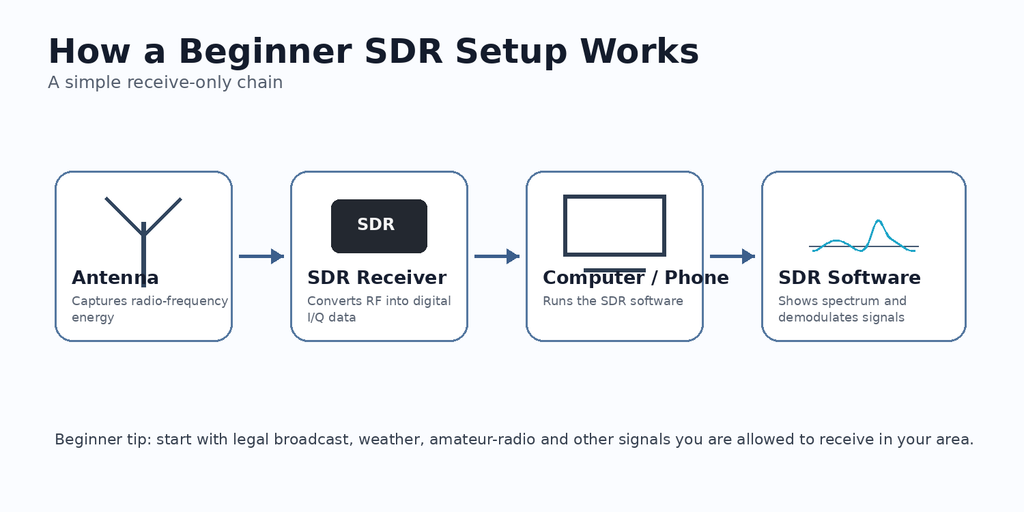
A beginner SDR is easiest to understand as a four-part chain: antenna, receiver, computer and software.
What Matters Most in a Best SDR Software Defined Radio for Beginners?
- Price without hidden extras: A cheap dongle is not a bargain if you immediately need an antenna, adapters and a better clock. Starter bundles can be easier because the basic accessories are already included.
- Frequency coverage: Beginners usually benefit from broad coverage rather than a receiver optimized for one narrow purpose. Wide coverage gives you more experiments to try while you discover what interests you.
- Frequency stability: A TCXO (temperature-compensated crystal oscillator) helps a receiver stay closer to the tuned frequency as it warms up. That matters more for narrow digital signals than it does for simply listening to wide FM broadcasts.
- ADC resolution and dynamic range: Budget RTL-SDR receivers use an 8-bit ADC. More expensive receivers such as the RSP1B use higher-resolution conversion at lower sample rates, which can help when strong and weak signals are close together.
- Instantaneous bandwidth: This is how much spectrum the SDR can view at once. A budget RTL-SDR typically shows a few MHz. The RSP1B can monitor up to 10 MHz, which makes band exploration feel more spacious.
- Software support: Good hardware is frustrating if the software is difficult to install. Choose a receiver with active drivers and compatibility with established programs.
- Antenna quality: The antenna often changes reception more than upgrading the receiver. A modest SDR connected to a suitable, well-positioned antenna can outperform a more expensive radio using a poor antenna.
1. Nooelec NESDR SMArt v5 Bundle – Best Overall Best SDR Software Defined Radio for Beginners
Why it leads our 2026 list: it is still actively sold, the price is accessible, the bundle includes three antenna masts, and the hardware has the stability features beginners usually want without moving into a much more expensive class.
The SMArt v5 is based on the familiar RTL2832U platform and uses a 0.5 PPM TCXO. Nooelec specifies approximately 100 kHz to 1.75 GHz tuning capability and up to 3.2 MHz instantaneous bandwidth. HF reception below roughly 25 MHz uses direct sampling, so beginners mainly interested in shortwave should understand that a dedicated HF-focused receiver or an upconverter can provide a cleaner experience.
The bundle is particularly attractive because it removes one of the classic first-day annoyances: buying a receiver and discovering you have no suitable antenna. The included telescopic and fixed-frequency antenna masts are not the final word in performance, but they are enough to begin experimenting.
Another practical advantage is size. The SMArt v5 is narrow enough to fit beside other USB devices more easily than many wider dongles. That sounds minor until a laptop has closely spaced ports.
Who Should Buy This Best SDR Software Defined Radio for Beginners?
- Someone who wants the lowest-cost sensible entry point without buying a no-name generic dongle.
- A beginner interested in FM radio, weather signals, amateur-radio reception, ADS-B experiments or general spectrum exploration.
- A student or hobbyist who wants a receiver that works on Windows, macOS, Linux or Android.
Main Limitations of This Best SDR Software Defined Radio for Beginners
- It is still an 8-bit RTL-SDR design, so very strong local signals can be more challenging than on higher-end receivers.
- HF reception works, but it is not the strongest reason to choose this model.
- The included antennas are starter equipment. Expect antenna upgrades to become your next purchase if the hobby sticks.
2. SDRplay RSP1B – Best Premium Best SDR Software Defined Radio for Beginners
The RSP1B costs much more than an RTL-SDR dongle, but it is easier to justify if you already know that radio will be more than a weekend experiment. SDRplay positions it as an entry-level receiver, yet its specifications put it well above the budget dongle class.
It provides continuous coverage from 1 kHz to 2 GHz, uses a 14-bit ADC at lower sample rates, includes multiple automatically selected front-end filters, has switchable AM, FM and DAB notch filters, a 0.5 PPM TCXO and a software-selectable bias tee. It can display up to 10 MHz of spectrum.
The result is not simply ‘more frequencies.’ The main benefit is cleaner behavior when the radio environment is crowded. Strong local broadcasters can overload inexpensive receivers. The RSP1B’s filtering and higher-resolution architecture give you more headroom to work with.
Who should buy it?
- A beginner who is especially interested in HF and wants one receiver that can grow with the hobby.
- Someone living near strong FM or AM broadcast transmitters who wants better built-in filtering.
- A user who values SDRplay’s SDRconnect software and wider visible bandwidth.
Main limitations
- The price is several times higher than a basic RTL-SDR starter bundle.
- No antenna is included, so the real first-day cost is higher.
- It offers more controls and capability than a complete beginner actually needs for basic FM listening.
3. RTL-SDR Blog V4 – Still Excellent, but Not the Default New Buy in 2026
The RTL-SDR Blog V4 earned its reputation for good reason. It improved HF reception, filtering, power design and frequency stability while keeping the familiar low-cost RTL-SDR ecosystem. Its published range is about 500 kHz to 1.766 GHz, with 2.56 MHz stable bandwidth and a 1 PPM TCXO.
The problem is availability, not capability. In May 2026, RTL-SDR Blog announced that V4 production had ended because the R828D tuner was no longer available in usable quantities. That changes the buying advice. A product can still be technically excellent while no longer being the smartest recommendation for a beginner who needs something easy to buy and support.
If you already own a genuine V4, keep using it. If you find new old stock at a normal price, it can still be a fine choice. What I would not do is pay a large scarcity premium simply because older buying guides call it the universal beginner recommendation.
Best SDR Software for Beginners
The receiver is only half of an SDR setup. The software is where you see the spectrum, choose a frequency, set the modulation mode and listen. Beginners do not need to install everything at once.
| Software | Best for | Why beginners use it |
|---|---|---|
| SDR++ | Best general-purpose cross-platform starting point | Modern interface, broad hardware support and a familiar waterfall/spectrum layout. Good choice if you switch between Windows, Linux and macOS. |
| SDR# (SDRSharp) | Best-known Windows option for RTL-SDR | Popular on Windows and supported by a large ecosystem of plugins and guides. It is often the program used in beginner RTL-SDR tutorials. |
| SDRconnect | Best match for SDRplay hardware | SDRplay’s current cross-platform application. If you buy an RSP1B, this is the most straightforward first program to try. |
| GQRX | Simple Linux/macOS listening | A long-running receive-focused option that is useful for basic tuning and spectrum viewing. |
A Simple First-Day Setup
- Install the driver and one SDR program. Follow the receiver manufacturer’s current instructions. Do not install five different SDR applications before confirming the first one works.
- Connect the starter antenna. Place it near a window or in a clear indoor location. Keep it away from noisy chargers, monitors and USB power supplies if possible.
- Tune to a strong, familiar broadcast. A local FM station is a good first test because you already know what successful reception should sound like.
- Set gain carefully. More gain is not always better. Too much gain can overload the receiver and create false signals or a raised noise floor.
- Explore the waterfall. Look for bright vertical or horizontal features and tune to them. This visual connection between frequency and sound is where SDR starts to make sense.
- Change one thing at a time. Move the antenna, adjust gain, change bandwidth or try a new band – but not all at once. That way you learn what each control actually changes.
The Antenna Matters More Than Most Beginners Expect
An SDR receiver does not create signals; it can only work with what the antenna delivers. That means a receiver upgrade is not always the best way to improve results. To use AI tools safely with your new SDR setup, read our guide on AI Regulation Updates 2025.
A telescopic starter antenna is useful for learning, but its performance changes with frequency and placement. For aircraft tracking, weather satellites, HF listening or a specific amateur band, a purpose-built antenna can make a much larger difference.
Start with the included antenna if your kit has one. Learn the software first. Once you know which signals you enjoy, buy or build an antenna for that purpose rather than collecting random accessories.
What Can a Beginner Listen To?
Examples of lawful, beginner-friendly receive-only activities include:
- Local AM and FM broadcast radio.
- Amateur-radio transmissions that are legal to receive in your jurisdiction.
- Weather-radio and weather-satellite signals where available.
- ADS-B aircraft position broadcasts where reception is permitted.
- AIS ship-position broadcasts in coastal areas where reception is permitted.
- Unlicensed ISM-band devices and educational RF experiments using your own equipment.
Legal note: Radio-reception laws vary by country and sometimes by signal type. Do not use an SDR to access private, encrypted or otherwise restricted communications. If you are unsure, check the rules that apply where you live.
Common Beginner Buying Mistakes
- Buying the cheapest generic dongle: A few dollars saved can mean a drifting oscillator, poor shielding, weak connectors and confusing driver support.
- Choosing an advanced transceiver as the first device: A receiver-first setup is cheaper and easier to learn. Most beginners need good reception and software support, not every possible feature.
- Ignoring the antenna connector: Most beginner SDRs use SMA connectors, but antennas and adapters come in several standards. Check before ordering accessories.
- Expecting the included antenna to cover everything perfectly: Starter antennas are learning tools, not optimized solutions for every frequency.
- Assuming more gain always improves signals: Too much gain can overload a receiver and make reception worse.
- Following an old ‘best SDR’ list without checking availability: This matters in 2026 because the RTL-SDR Blog V4 reached end-of-line even though many older guides still recommend it as the default purchase.
Beginner SDR Comparison
| Model | Approx. price* | ADC | Max visible BW | HF | Best use |
|---|---|---|---|---|---|
| Nooelec NESDR SMArt v5 Bundle | ~$55 | 8-bit | Up to 3.2 MHz | Direct sampling | Low-cost first SDR |
| SDRplay RSP1B | ~$144 | Up to 14-bit | Up to 10 MHz | Strong all-round coverage | Premium beginner / long-term use |
| RTL-SDR Blog V4 | Varies; EOL | 8-bit | 2.56 MHz stable | Built-in upconverter | Existing owners / remaining stock |
*Prices are approximate figures checked in August 2026 and can change by region, tax, shipping and remaining stock.
Which SDR Should a Beginner Buy?
If you want the simplest answer, buy a reputable low-cost receive-only kit and spend the rest of your energy learning antennas and software. In August 2026, the Nooelec NESDR SMArt v5 Bundle is the easiest recommendation for that role because it is available, supported and includes the basics needed to begin.
Choose the SDRplay RSP1B instead if your budget is comfortable around the mid-$100 range and you already expect to spend serious time with HF, crowded bands or spectrum analysis. The extra filtering, ADC resolution and wider bandwidth give it more room to grow.
Do not feel that you have to buy the most advanced hardware to ‘do SDR properly.’ A beginner who understands gain, antennas, modulation and the waterfall will get more from a modest receiver than a newcomer who buys expensive hardware but never learns the basics.
Frequently Asked Questions
What is the best SDR software defined radio for beginners in 2026?
For most first-time buyers, the Nooelec NESDR SMArt v5 Bundle is the best balance of price, current availability, included antennas and broad software support. The SDRplay RSP1B is the better premium choice.
Is RTL-SDR Blog V4 still worth buying?
It is still capable hardware, but production ended in 2026. It makes sense if you already own one or find genuine remaining stock at a normal price. It is no longer the easiest default recommendation for a new buyer.
Do I need a ham radio license to use an SDR receiver?
A receive-only SDR does not transmit. Listening rules depend on local law and signal type, so follow the regulations where you live. Transmitting on amateur bands is a different activity and normally requires the appropriate license.
What software should I install first?
SDR++ is a good general-purpose option across major desktop platforms. Windows RTL-SDR users also commonly start with SDR#, while SDRplay owners can begin with SDRconnect.
Can I use an SDR with a phone?
Many RTL-SDR receivers can work with Android devices using compatible USB adapters and software. Power consumption and driver support vary by phone.
Do I need an expensive antenna?
No. Use the included starter antenna first if your bundle has one. Upgrade only after you know which frequencies or projects interest you.
Can an SDR transmit?
The beginner receivers recommended in this guide are receive-only. That keeps setup simpler and is enough for learning spectrum, radio modes and signal reception.
What is the difference between an SDR and a normal scanner?
A traditional scanner usually provides a purpose-built interface for scanning channels. An SDR sends a block of radio spectrum to software, giving you a visual waterfall and much more flexibility in filtering, recording and decoding.
How This Guide Was Researched
This guide was written for beginners rather than for experienced RF engineers. Current manufacturer specifications, availability and product status were checked in August 2026. The recommendations prioritize current availability, beginner cost, software compatibility, included accessories and room to grow. Prices are treated as approximate because radio hardware pricing and stock can change quickly.