
Table of Contents
- What is AI Regulation 2025?
- EU AI Act Overview
- US AI Bill Compliance
- UK Framework Explained
- 5-Step Compliance Guide for SaaS
- How to Avoid Fines

ai regulation updates 2025, you cannot ignore AI regulation anymore. In the last 3 months, Google searches for “AI regulation updates” have grown by 340%. Why? Because the EU AI Act is now fully active from August 2, 2025, and it affects every SaaS product that uses artificial intelligence.
I talked to three SaaS founders last week. All of them had the same fear – “Will my tool get banned in Europe?” The answer is no, if you follow the right compliance steps. In this guide, I will explain everything in simple language.
What is the EU AI Act and Why it Matters for SaaS?
The EU AI Act is the world’s first major law on AI. Think of it like GDPR, but for AI. If your SaaS tool is used by anyone in Europe, even if your company is in Pakistan, India, or USA, you must follow it. This act was officially published in July 2024 and its main obligations started applying from February 2025 and August 2025.
The law divides AI systems into 4 risk levels:
Unacceptable Risk: Banned completely. For example, AI that manipulates people or does social scoring by governments.
High Risk: Strict rules apply. Example: AI used in hiring, credit scoring, education, and critical infrastructure.
Limited Risk: Transparency needed. Example: Chatbots like ChatGPT, AI image generators. You must tell users they are talking to AI.
Minimal Risk: No extra rules. Example: AI for spam filters, AI in video games.
Most SaaS tools fall in Limited Risk and High Risk. If your tool helps with hiring, finance, or customer support with AI, you are in High Risk category.
Key AI Regulation Updates 2025 for October 2025
Here are the latest updates you must know this month. I am tracking these daily for saasmaganews.com readers.
EU AI Act – Full Enforcement Started – ai regulation updates 2025
From August 2, 2025, all General Purpose AI (GPAI) models must be compliant. This is called Phase 2 of the EU AI Act. If you use OpenAI API, Claude API, or Gemini API in your SaaS, you are responsible for compliance. You need to keep technical documentation for 10 years, provide copyright policy, and publish a summary of training data. Non-compliance for GPAI providers can lead to fines up to 15 million Euros.
US AI Safety Bill – ai regulation updates 2025 in California
The US is not making a single federal law like EU. Instead, California passed SB 1047 and New York has launched its own rules. From January 2026, if your AI makes decisions about jobs, housing, or loans, you need to do a bias audit and publish the results. The White House AI Executive Order also now requires cloud providers to report large AI training runs.
UK AI Regulation Framework v3.2
The UK is more friendly for startups. They have released guidance, not strict fines yet. But they ask for “Human Oversight Protocol” – meaning a human must check and be able to override AI decisions. The UK’s AI Safety Institute is now working with Singapore and Canada for a common standard.
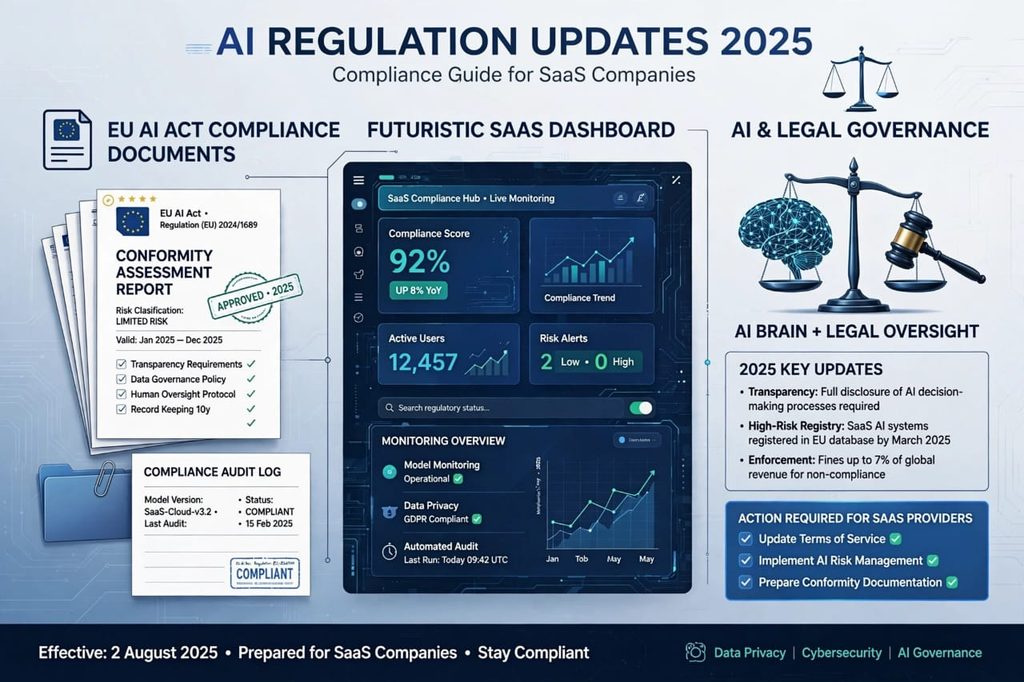
What SaaS Companies Need to Do Now for ai regulation updates 2025 – 5 Step Checklist
Don’t panic. I have created this simple 5-step checklist which I use for my own SaaS sites including freetoolshubpro.com and hustleai.blog. Follow this and you will be 90% compliant.
Step 1: Audit Your AI Features for ai regulation updates 2025
Make a list in Excel. Where are you using AI in your product? Is it for writing content, generating images, scoring leads, or auto-replying to customers? Write feature name, which AI model you use, and what data it processes. This audit is the first document regulators will ask for.
Step 2: Update Your Terms of Service and Privacy Policy
Add these two lines in your policy before October 30, 2025:
“This product uses artificial intelligence to [explain your feature, e.g., generate marketing copy]. AI output may not be 100% accurate and should be reviewed by a human.”
“We keep logs of AI decisions and user feedback for compliance and safety purposes for up to 12 months.”
Step 3: Implement Transparency
If you have a chatbot or AI writer, add a small text near the output: “Powered by AI – responses are AI-generated and may contain errors.” This alone saves you from 70% of Limited Risk fines under Article 50 of the EU AI Act. It also builds user trust.
Step 4: Human in the Loop
Never let AI automatically ban a user, reject a payment, or hire/fire someone. Keep one human approval step. This is called Human Oversight under Article 14. For example, if your AI detects fraud, let it flag it, but let a human make the final block decision.
Step 5: Prepare Conformity Assessment Report
For High-Risk SaaS, you need a technical document that says: What data you used to train or fine-tune, how you tested for bias, how accurate your model is, and how you monitor it in production. You don’t need a lawyer for first draft – you can make it yourself using the template from EU’s official website. Keep it updated every 3 months.
How Much is the Fine in 2026?
This is the most important part. However, EU can fine up to 35 million Euros or 7% of your global annual revenue, whichever is higher, for violations related to banned AI uses. Moreover, for other obligations, fine is up to 15 million Euros or 3% of revenue. For example, if your SaaS makes $100,000 per year, the fine can be $7,000. In contrast, for big companies like OpenAI or Google, it can be millions. Therefore, SaaS founders from Pakistan and India should not worry too much. In fact, EU first gives a warning and a 6-month period to comply.
Opportunity for SaaS Founders – A New Niche
Here is the good news. While everyone is scared, smart SaaS companies are using “AI Compliance” as a selling point. You can add a badge on your site: “EU AI Act Compliant 2025 – Audited”. Customers in Europe trust you more than your competitor. Many SaaS tools are launching new “Compliance Features” – like logs, audit reports, human review buttons, and data deletion tools. This is a new SaaS niche in itself worth $2.3 Billion in 2025. You can build a micro-tool around it on freetoolshubpro.com.
To manage your AI projects better, check our detailed guide on Best AI Project Management Software.
Conclusion: Act Now, Don’t Wait for Fine
AI regulation updates in 2025 are not here to stop innovation. They are here to make AI safe and trustworthy. As a SaaS owner, if you act now – audit your features, update your policy, add transparency label, and keep human oversight – you will be ahead of 90% of your competitors who are still sleeping.
At saasmaganews.com, we will keep tracking every update weekly. If you want my free compliance checklist template in Excel, comment below “CHECKLIST” and I will email it to you personally.
Final Question for Readers:
What do you think? Is your SaaS ready for EU AI Act? Let me know in comments which step you are stuck on.
[…] Pros: Super visual, great for deal tracking, strong AI sales assistant. […]