
EU AI Act compliance for SaaS is now essential for every SaaS founder. If you are running a SaaS company, even if you are based outside Europe, the EU AI Act is no longer someone else’s problem. I have seen many SaaS teams think, “We are a US or Asian company, EU laws don’t apply to us.” That is the biggest mistake.
If you are running a SaaS company, even if you are based outside Europe, the EU AI Act is no longer someone else’s problem. I have seen many SaaS teams think, “We are a US or Asian company, EU laws don’t apply to us.” That is the biggest mistake.
The EU AI Act is the world’s first comprehensive legal framework for Artificial Intelligence. It has extraterritorial effect. That means if your SaaS product uses AI and is used by even one user in the European Union, you must comply.
The penalties are serious. We are talking about fines up to 35 million Euros or 7% of your global annual turnover, whichever is higher. For a growing SaaS startup, that can be the end of the road.
But compliance is not just about avoiding fines. It is about trust. When you tell your enterprise customers that you are EU AI Act compliant, you instantly become more trustworthy than 90% of your competitors.
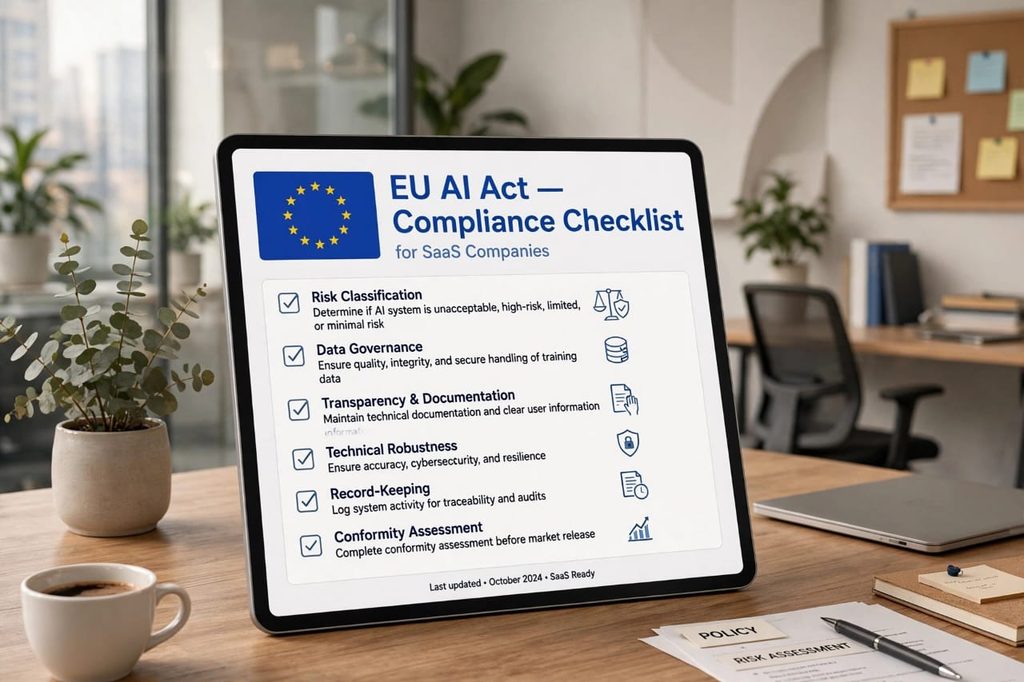
What is the EU AI Act in Simple Words?
Forget the legal jargon. The EU AI Act is simple. The EU has decided to categorize all AI systems based on how risky they are for people.
It does not ban all AI. It says, if your AI can harm someone’s rights, safety, or livelihood, you need to be extra careful. If your AI is low-risk, you have fewer obligations.
For SaaS companies, this is critical because almost every modern SaaS tool now has some AI inside – whether it is an AI chatbot for support, an AI that scores leads in your CRM, an AI that writes marketing copy, or an AI that shortlists job candidates.
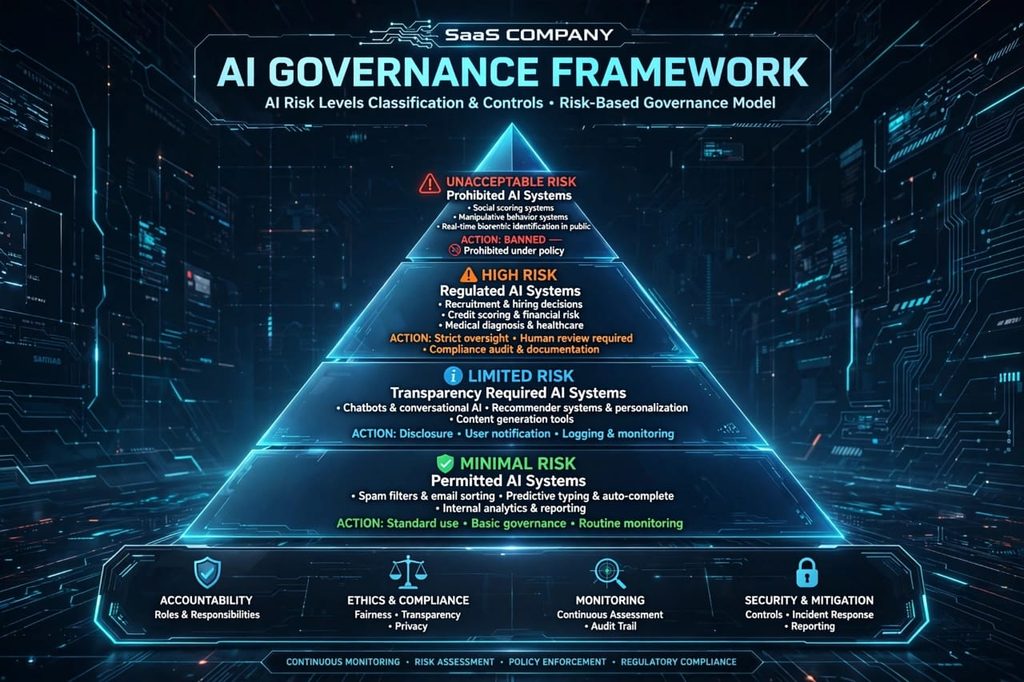
The Four Risk Levels You Must Understand
This is the heart of the Act. You cannot comply unless you know where your product falls.
1. Unacceptable Risk – Banned
These are AI systems that are considered a clear threat. For example, social scoring systems, AI that manipulates people to make harmful decisions, real-time remote biometric identification in public spaces for law enforcement. If your SaaS does any of this, you must stop immediately.
2. High Risk – Strictly Regulated
This is where most B2B SaaS companies get caught. If your SaaS is used for recruitment and hiring, credit scoring, insurance risk assessment, education scoring, or critical infrastructure management, you are likely High Risk. You will need to do a lot of work to comply.
3. Limited Risk – Transparency Required
This covers most general SaaS AI features like chatbots, AI content generators, recommendation engines. Your main job here is to be transparent. You must tell the user they are talking to an AI or that the content is AI-generated.
4. Minimal Risk – Free to Use
Things like spam filters, AI-powered inventory management, or AI in video games. No major restrictions, but you are still encouraged to follow voluntary codes of conduct.
Complete Compliance Checklist for SaaS Companies – 12 Steps
Step 1: Create an AI Inventory
Make a list of every single place where AI is used in your SaaS. Not just your main feature. Check your internal tools too. Are you using a third-party AI API from OpenAI or Anthropic? List everything.
Step 2: Classify Your Risk Level
For each AI system in your inventory, classify it into one of the four levels above. Be honest. For example, if your AI HR SaaS helps companies filter resumes, that is High Risk under the EU AI Act.
Step 3: Determine Your Role – Provider or Deployer?
If you built the AI system and sell it under your name, you are a Provider. You have the most obligations. If you are using a third-party AI model and just offering it to your customers, you are a Deployer.
Step 4: Implement Data Governance
For High-Risk systems, your training data must be high-quality, relevant, and free of bias as much as possible. You need to document where your data came from, how you cleaned it, and how you checked for bias.
Step 5: Build Technical Documentation
You need to create a technical file before you put your AI system on the market. This file should include the purpose of your AI system, how it was designed, its accuracy levels, how it was tested, and what risks you have identified. For more details, check our guide on AI Governance: Why AI Transformation Is a Problem of Governance.
Step 6: Ensure Human Oversight
No High-Risk AI system can be fully autonomous under the EU AI Act. You must have a human in the loop who can understand the system, override its decisions, and intervene if something goes wrong.
Step 7: Guarantee Transparency and User Information
For Limited Risk systems like chatbots, you must clearly inform users. A simple line like “You are chatting with our AI assistant” is enough.
Step 8: Set Up Logging and Record-Keeping
Your AI system must automatically log its operations. These logs should be kept for at least 6 months and be traceable.
Step 9: Conduct a Fundamental Rights Impact Assessment
Before deploying a High-Risk system, you need to assess how it might affect people’s fundamental rights. For example, could your AI hiring tool discriminate against a certain group?
Step 10: Establish Post-Market Monitoring
Compliance is not a one-time task. You need a system to monitor your AI after it is deployed. Collect feedback, track performance drift, and watch for incidents.
Step 11: Create an Incident Reporting Plan
If a serious incident occurs, you have 15 days to report it to the relevant national authority in the EU. Have a plan ready.
Step 12: Prepare a Conformity Assessment
For High-Risk systems, you will need to go through a conformity assessment to prove you meet all requirements. Once you pass, you can affix the CE marking to your product.
Common Mistakes SaaS Companies Make
I have seen three common mistakes. First, thinking that using an API from a big provider like OpenAI makes you exempt. It does not. Second, ignoring General Purpose AI (GPAI) rules. Third, waiting until the last minute. Compliance takes 3-6 months to implement properly.
Conclusion: Compliance is a Competitive Advantage
The EU AI Act may look scary at first, but it is actually an opportunity. SaaS buyers, especially enterprise buyers in Europe, are now actively asking vendors, “Are you EU AI Act compliant?” If you can say yes and show them your documentation, you win the deal.
Start with Step 1 and Step 2 today. For more updates, you can read our other guides on AI Compliance News and AI Regulation Updates.
Frequently Asked Questions (FAQs)
Q1: Does the EU AI Act apply to my SaaS if my company is not in the EU?
Yes, it does. If your AI system is placed on the EU market or its output is used in the EU, the Act applies to you, regardless of where your company is headquartered. This is similar to GDPR.
Q2: What is the deadline for EU AI Act compliance for SaaS companies?
The Act is being rolled out in phases. Prohibitions on unacceptable risk were effective from February 2025. Obligations for General Purpose AI models apply from August 2025. Most obligations for High-Risk systems will become mandatory by August 2026. So you should start now.
Q3: What is the difference between High Risk and Limited Risk for a SaaS chatbot?
A standard customer support chatbot that answers FAQs is Limited Risk. You just need to disclose it is an AI. But if that same chatbot is used to automatically reject job applicants or approve loans, it becomes High Risk.
Q4: Do I need to retrain my AI model to be compliant?
Not necessarily, but you might need to. If your model is biased or trained on poor quality data, you will need to retrain it. At minimum, you need to document your data governance and testing processes.
Q5: How much will EU AI Act compliance cost for a small SaaS startup?
For a small SaaS with one or two AI features classified as Limited Risk, the cost is mostly time and documentation. For High-Risk systems, it can be much more, including costs for conformity assessment and ongoing monitoring.