
AI governance is the reason AI transformation is a problem of governance because the hardest enterprise questions are not about whether a model can generate an answer. They are about who may use the system, which data it can access, what evidence is required before production, who owns the business outcome, who accepts residual risk, how mistakes are escalated, and who can pause or retire the system. Technology makes transformation possible; AI governance decides whether it can scale safely and produce durable value.
Why this idea matters now
Companies have spent the last few years proving that generative AI can draft, summarize, classify, search, code and automate. The bottleneck has shifted. Once AI touches real workflows, it also touches permissions, budgets, customer outcomes, employee roles, data rights, security boundaries and legal obligations. At that point, AI stops being a software experiment and becomes an operating-model decision.
That is why the phrase “AI transformation is a problem of governance” has become more useful than the older framing of AI as a tool rollout. Zapier used the same thesis in a May 2026 guide, arguing that governance gives teams the rules and guardrails needed to move from experimentation into daily work. PwC’s July 2026 board guidance goes further: boards should treat AI as an enterprise transformation affecting strategy, capital allocation, operations, talent, culture and risk—not simply as a technology initiative.
AI governance framework showing practical governance stack
AI adoption means people start using AI tools. AI transformation means the organization redesigns how work gets done because AI is part of the workflow. AI governance is the system of decision rights, policies, controls, evidence, accountability and review that makes that redesign manageable.
| Concept | Main question | Typical signal | Common mistake |
|---|---|---|---|
| AI adoption | Are people using AI? | Tool usage rises | Counting licenses as transformation |
| AI transformation | Has work been redesigned? | Cycle time, quality or business model changes | Automating a broken workflow |
| AI governance | Can the organization control and explain AI use? | Named owners, approvals, monitoring and stop rules | Writing a policy nobody operationalizes |
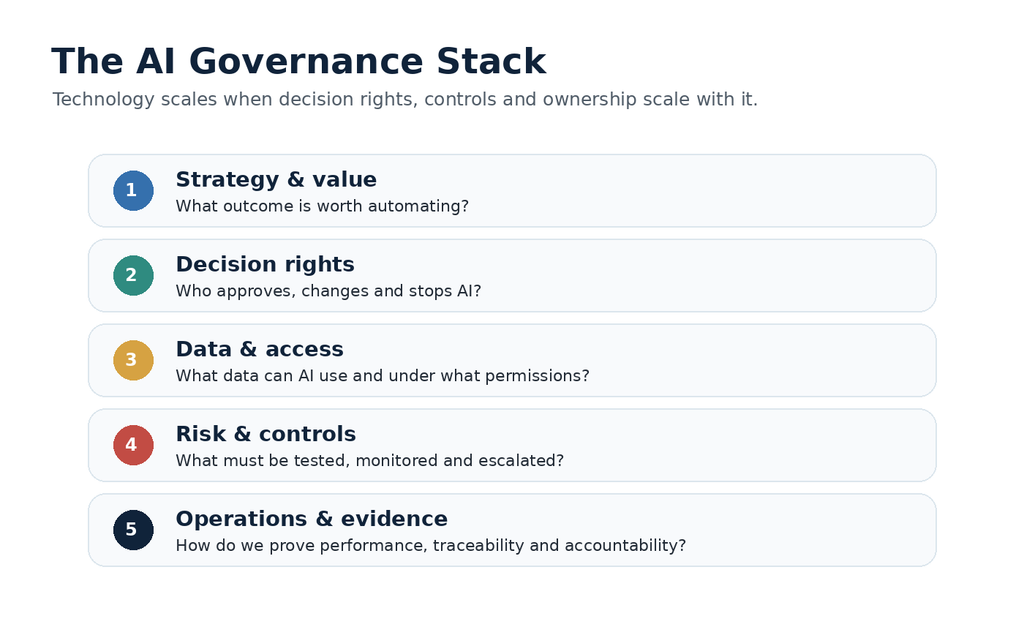
Figure 1. A practical governance stack: business value sits on top of clear decision rights, controlled data, risk management and operational evidence.
Why AI transformation stalls without governance
An AI pilot can look successful in a demo and still fail in production. A model may be technically capable, yet the organization may have no agreed answer to basic operating questions. Who is allowed to change the prompt? Who approves a new data source? What happens if the model starts giving materially worse outputs after a vendor update? Who tells customers that AI was involved? Which team owns the cost after the pilot budget ends?
1. Ownership becomes blurry
AI often crosses departments. A customer-service agent might use product data, customer history, a third-party model and internal policy documents. Product may own the workflow, IT may own integration, security may own access, legal may own regulatory interpretation, and the business may own the customer outcome. If accountability is split but not designed, important decisions can fall between teams.
2. Data access changes the risk profile
AI systems become more useful when connected to real company data, but that same connection raises questions about confidentiality, personal data, intellectual property, retention, access controls and vendor handling. Governance is what turns “the model can access this” into “the model is allowed to access this, for this purpose, under these controls.”
3. Probabilistic systems require ongoing monitoring
Traditional software is usually expected to behave predictably under the same inputs. Generative systems can be more variable, and model or vendor changes can alter behavior. That makes pre-launch testing necessary but not sufficient. Organizations also need monitoring, escalation thresholds, review dates and a clear stop mechanism.
4. Value and risk must be governed together
Bad governance can be too weak, but it can also be too heavy. A governance program that treats every low-risk internal assistant like a high-stakes decision system can slow useful experimentation. Mature governance classifies use cases by impact and applies stronger controls where the consequences are greater.
What current frameworks say about AI governance
The governance thesis is not just a consulting slogan. Major frameworks increasingly describe AI risk as a lifecycle and management problem.
To avoid this confusion, companies must define clear decision rights as part of their AI governance framework.
NIST: govern, map, measure and manage risk
The U.S. National Institute of Standards and Technology created the AI Risk Management Framework to help organizations manage risks to individuals, organizations and society. Its generative AI profile extends that approach to risks specific to generative systems. NIST’s AI RMF is voluntary, but its structure is useful because it treats governance as something that spans design, development, deployment, use and evaluation—not a one-time approval.
OECD: accountability and traceability across the lifecycle
The OECD AI Principles emphasize transparency, robustness, safety and accountability. The accountability principle calls for traceability around datasets, processes and decisions, and for systematic risk management across the AI lifecycle. In its 2026 Digital Government Outlook, the OECD described strong governance as a cornerstone of successful AI adoption and noted that practical controls often lag behind high-level strategies.
EU AI Act: governance is now an enforcement reality
The regulatory context is also becoming more concrete. According to the European Commission, from 2 August 2026 the AI Office and authorities in EU member states are responsible for implementing, supervising and enforcing the AI Act, while some high-risk-system requirements will apply later. For organizations operating in or serving the EU, governance therefore has to connect policy, technical documentation, risk classification, oversight and evidence to real compliance responsibilities.
Also read our guide on AI regulation updates in 2025 to understand compliance requirements for AI governance.
ISO/IEC 42001: manage AI as a system, not a collection of tools
ISO/IEC 42001:2023 is an international management-system standard for organizations that provide or use AI-based products and services. Its importance is conceptual as much as procedural: it treats AI governance as a repeatable management system with policies, responsibilities, risk assessment, controls and continuous improvement rather than as a set of disconnected project checklists.
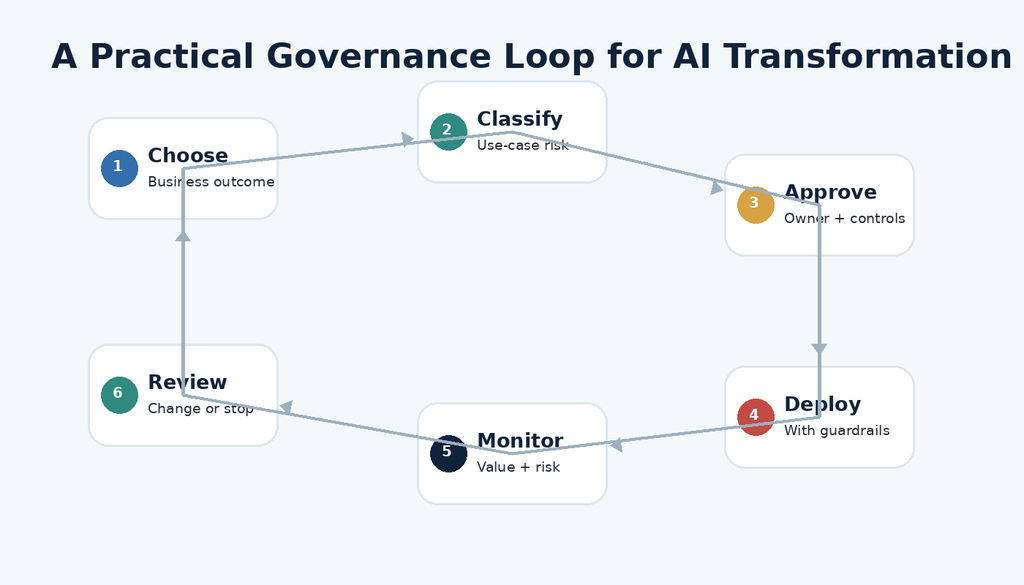
Figure 2. Governance should be continuous: select, classify, approve, deploy, monitor, then review or stop.
A practical AI transformation governance model
Step 1: Start with a business outcome, not a model
Define the workflow, user, decision and measurable outcome before choosing the model. Useful measures include cycle time, cost per case, error rate, customer resolution, revenue lift, employee time saved or risk reduction. A model demo is not a business case.
This is why many enterprises now review AI regulation updates in 2025 before connecting internal systems to generative models.
Step 2: Classify the use case by impact
Separate low-impact assistance from higher-impact systems. An internal drafting assistant and an AI system influencing hiring, credit, health, safety or legal rights should not pass through the same control path. Classification helps the organization scale controls proportionally.
Step 3: Name one accountable business owner
The owner should be responsible for the business outcome and for making sure required reviews happen. Technical teams can own model performance, but someone in the business must own the decision to use AI in that workflow.
Step 4: Define data and permission boundaries
Document which systems and datasets the AI can access, what it may retain, what it may send to a vendor, which user roles can invoke it and which actions require human approval. Permissions should follow least-privilege principles wherever possible.
Step 5: Set production evidence before launch
Decide in advance what evidence is sufficient for go-live. That may include evaluation results, security review, privacy review, bias or quality testing, fallback behavior, human-oversight design, incident procedures and documentation.
Step 6: Monitor both value and risk
Track whether the system is creating the promised outcome and whether its risk profile is changing. A system that is safe but useless should be reconsidered; a system that creates value but develops unacceptable risk should be paused or redesigned.
Step 7: Give someone explicit stop authority
Every production AI system should have a clear path for pausing, restricting or retiring it. This avoids the situation where everyone sees a problem but nobody knows who is authorized to act.
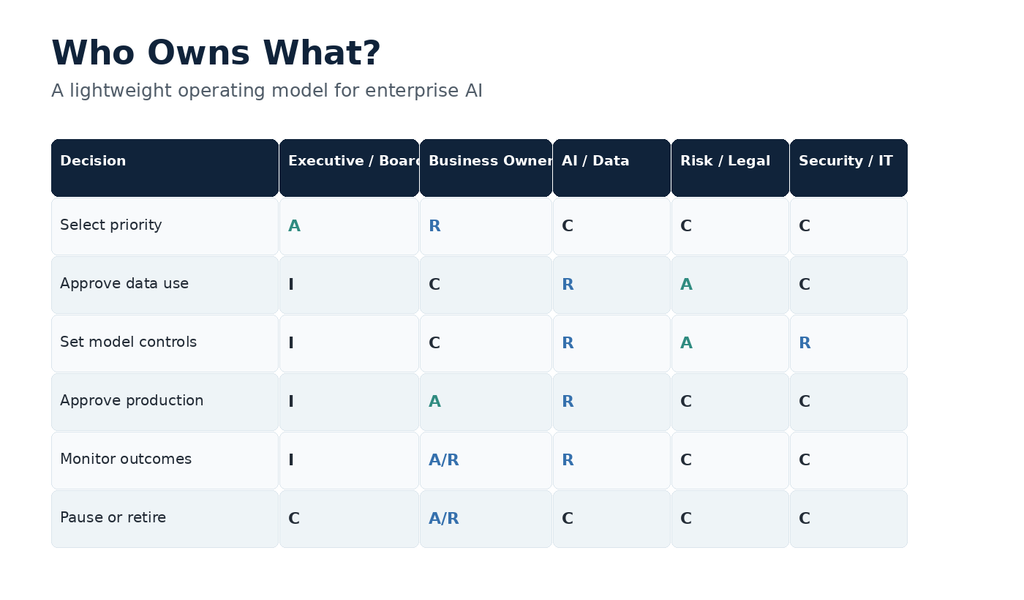
Figure 3. Example ownership matrix. R = Responsible, A = Accountable, C = Consulted, I = Informed. Adapt it to the organization and use-case risk.
The 2026 challenge: shadow AI and agentic systems
Governance becomes harder when employees can access AI through many tools, browser features, SaaS platforms and embedded assistants. This is often described as shadow AI: use that exists outside formal inventory, review or monitoring. The answer is not simply to ban AI. Organizations need visibility, approved pathways, clear rules for sensitive data, and safe low-friction options that make compliant behavior easier than workaround behavior.
Agentic AI raises the stakes further because software may take actions, call tools or operate across systems with less step-by-step human input. The governance question shifts from “what can the model say?” to “what can the system do, with whose identity, under what permissions, and how quickly can the organization detect and stop undesirable behavior?”
What should leaders measure?
Governance should not become a paperwork factory. The best metrics show whether AI is creating value, operating within defined risk boundaries and remaining understandable enough to control.
| Metric group | Examples | Why it matters |
|---|---|---|
| Business value | Cycle time, cost, quality, conversion, resolution rate | Shows whether transformation is producing a real outcome |
| Adoption | Active users, workflow coverage, completion rate | Shows whether the redesigned process is actually being used |
| Model/system quality | Accuracy, groundedness, error severity, refusal quality | Tracks performance relevant to the use case |
| Risk | Incidents, policy breaches, data exposure, harmful outputs | Shows whether controls are containing material harm |
| Oversight | Human overrides, escalations, review completion | Shows whether governance works in practice |
| Change | Model updates, prompt changes, new tools/data sources | Makes drift in the operating environment visible |
A simple AI governance maturity model
Level 1 — Ad hoc: Teams experiment independently. There is little inventory, ownership or consistent review.
Level 2 — Policy-led: The organization has AI rules, but workflows still depend on manual interpretation and informal approvals.
Level 3 — Operational: Use cases are inventoried, classified and assigned owners. Reviews and production gates are repeatable.
Level 4 — Measured: Controls are connected to business and risk metrics. Changes, incidents and outcomes are continuously reviewed.
Level 5 — Adaptive: Governance is embedded into platforms and workflows, allowing fast experimentation within clear boundaries.
30-day action plan for organizations starting now
A company does not need a giant committee to begin. In the first 30 days, the objective is to create visibility and decision clarity.
- Week 1: Build a basic inventory of AI tools and production use cases.
- Week 1: Identify workflows that touch sensitive data, customers, employees or regulated decisions.
- Week 2: Assign a business owner to every material use case.
- Week 2: Define an impact/risk classification with a small number of tiers.
- Week 2: Decide which reviews are mandatory for each tier.
- Week 3: Document data-access rules, approved vendors and human-approval requirements.
- Week 3: Set minimum production evidence and incident-escalation rules.
- Week 4: Start a monthly review of value, incidents, model/vendor changes and newly discovered use cases.
- Week 4: Give named roles the authority to pause or retire systems when thresholds are breached.
Common governance mistakes
Treating governance as legal review only: Legal and compliance are essential, but governance also covers business ownership, security, data, operations, model quality, user behavior and value measurement.
Creating one approval path for every use case: Risk-based governance should be proportional. Low-risk experimentation needs lighter controls than decisions that materially affect people or regulated outcomes.
Approving a model instead of a system: Risk depends on the full context: data, prompts, tools, permissions, human roles, interfaces, vendors and downstream actions.
Measuring adoption without outcomes: High usage can still mean low value. Track the business result that justified the transformation.
Assuming launch ends governance: AI systems, models, vendors, prompts and data change. Governance must include post-deployment monitoring and review.
No clear stop rule: If nobody is authorized to pause a system, accountability exists only on paper.
Frequently asked questions
Why is AI transformation a governance problem?
Because scaling AI changes who can make decisions, what data can be used, how workflows operate, who accepts risk and who is accountable for outcomes. Models cannot decide those organizational questions by themselves.
Does AI governance slow innovation?
Poor governance can. Good governance should create clear, risk-based lanes so low-risk experimentation moves quickly while higher-impact uses receive stronger review.
Who should own AI governance?
No single function can own every part. A central governance group can set the framework, but business owners, AI/data teams, security, legal/risk and leadership all need defined responsibilities.
Is AI governance only about compliance?
No. Compliance is one part. Governance also includes strategy, value, data rights, permissions, quality, security, accountability, incident response and lifecycle management.
What is the difference between AI risk management and AI governance?
Risk management focuses on identifying, assessing and treating risks. Governance is broader: it defines who decides, who is accountable, which controls apply, what evidence is required and how the organization monitors value and risk over time.
How does the EU AI Act affect AI governance in 2026?
The European Commission states that from 2 August 2026 the AI Office and national authorities are responsible for implementing, supervising and enforcing the Act, while some high-risk requirements apply later. Organizations should map applicable duties to ownership, documentation and controls rather than treating the Act as a one-time legal checklist.
Final takeaway
AI transformation succeeds when organizations govern decisions, not just models. The technology layer matters, but it is no longer the only hard part. Sustainable transformation requires clear business outcomes, decision rights, accountable owners, controlled data access, proportional risk reviews, production evidence, ongoing monitoring and explicit stop authority. In 2026, those capabilities are becoming a competitive advantage as well as a risk-management requirement.
[…] To learn more, read our detailed guides on AI Regulation Updates 2025 and AI Governance. […]
[…] people think AI governance is just a boring legal term for big companies. But in reality, it is very simple and very practical. […]