
Artificial-intelligence compliance has moved beyond ethical principles and future promises. In 2026, businesses are managing active transparency duties, state-level restrictions, model documentation requirements, automated-decision rules and increasingly detailed expectations for evidence, oversight and incident response.
By Zulqarnain Zilli | Published: July 27, 2026 | Reviewed against official sources listed below
The most important development is timing. The European Union’s AI framework is entering a new operational phase: transparency duties for chatbots, synthetic content and certain public-interest AI text apply from August 2, 2026, while the European Commission’s enforcement powers over general-purpose AI providers also begin on that date. At the same time, the EU has extended major high-risk-system deadlines, creating a split compliance calendar that companies can easily misunderstand.
Outside Europe, the United States continues to combine federal policy with state-specific laws. Texas rules have been effective since January 1, 2026. California requires new forms of training-data and synthetic-content transparency. Colorado replaced its earlier AI law with an automated-decision framework that takes effect on January 1, 2027. The United Kingdom is updating automated-decision guidance and developing a principles-based approach for agentic AI and regulated sectors.
The result is a practical shift: AI compliance can no longer be handled only through a general “responsible AI” policy. Organizations need a current inventory of AI systems, clear risk classification, documented impact assessments, vendor evidence, technical logs, human-oversight controls and a process for keeping those records accurate when models, prompts, data sources or use cases change.
| Key takeawayThe central AI compliance question is no longer “Do we have an AI policy?” It is “Can we show which systems we use, why they are permitted, how they are controlled, who is accountable and what evidence proves those controls are working?” |
What Does “AI Compliance” Mean?
AI compliance is the process of ensuring that an organization’s development, procurement and use of artificial intelligence follows applicable laws, regulatory guidance, contractual commitments, sector rules and internal risk standards. It includes both legal requirements and the operational evidence needed to demonstrate that those requirements are being met.
A complete program normally covers:
- AI-system and vendor inventory
- Legal-role analysis: provider, developer, deployer, distributor or product manufacturer
- Risk and impact assessment
- Data protection, security, copyright and discrimination controls
- Accuracy, robustness and human-oversight testing
- User disclosures and AI-generated-content labels
- Technical documentation, logs and change records
- Incident reporting, complaint handling and remediation
- Employee AI literacy and approved-use policies
- Continuous monitoring after deployment
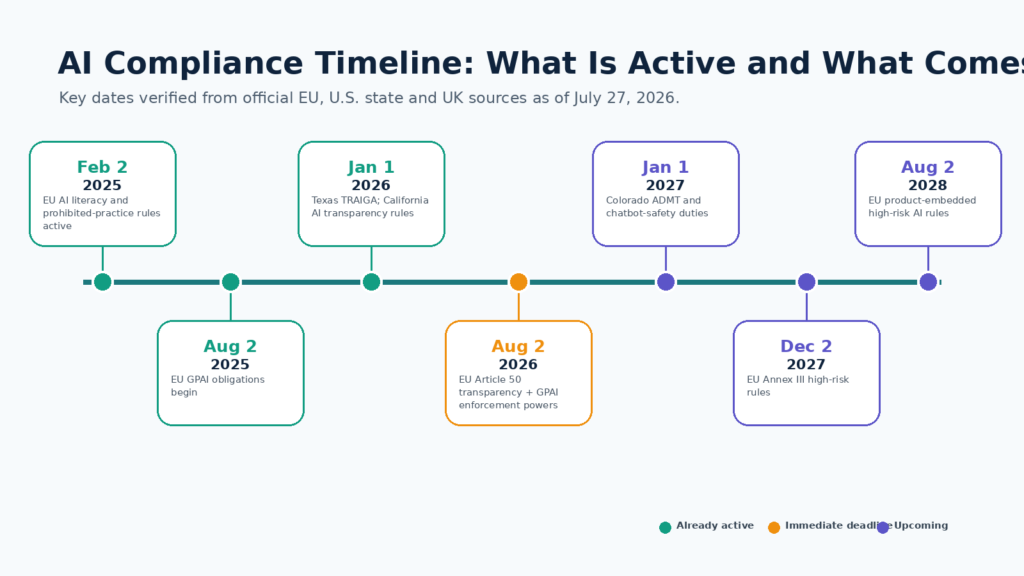
Figure 1. Selected AI compliance dates that are active or approaching. Always verify sector-specific and local obligations.
Latest AI Compliance News: 10 Developments Defining 2026
1. The EU split its compliance calendar instead of simply “delaying the AI Act”
On July 27, 2026, the EU’s Digital Omnibus changes entered into force. The update extends the application of rules for high-risk AI systems listed in sensitive areas such as employment, education, biometrics, critical infrastructure and public services to December 2, 2027. Rules for high-risk AI embedded in regulated physical products are scheduled for August 2, 2028.
This extension does not mean every 2026 duty disappeared. AI literacy and prohibited-practice provisions have applied since February 2, 2025. General-purpose AI obligations have applied since August 2, 2025. Transparency duties under Article 50 still become applicable on August 2, 2026. Companies must therefore maintain a requirement-by-requirement timeline instead of relying on a single “AI Act deadline.”
2. EU transparency rules become an immediate product and content requirement
From August 2, 2026, providers and deployers of certain interactive and generative AI systems face specific transparency obligations. Depending on the system and use case, these include informing people that they are interacting with AI, making AI-generated or manipulated outputs detectable in a machine-readable format, visibly disclosing deepfakes and disclosing certain AI-generated text published to inform the public on matters of public interest.
For product teams, this is not only a legal-page update. It may require interface notices, metadata or provenance mechanisms, content-labelling logic, accessibility review, localization, records showing when labels were applied and controls preventing downstream integrations from removing required disclosures.
3. EU enforcement powers over general-purpose AI providers begin on August 2, 2026
The European Commission’s enforcement powers for general-purpose AI model obligations enter into application on August 2, 2026. The obligations can include technical documentation, information for downstream providers, copyright-policy duties and—in the case of models with systemic risk—model evaluation, risk mitigation, incident reporting and cybersecurity measures. Providers of older models placed on the market before August 2, 2025 have a separate compliance date of August 2, 2027.
Businesses that merely buy or integrate a model should still request sufficient supplier documentation. A deployer cannot build a defensible assessment if the vendor contract, model limitations, version history, security responsibilities and incident-notification terms are unclear.
4. AI literacy is already a compliance control—not a future training project
The EU’s AI-literacy requirement has applied since February 2, 2025. Organizations should be able to explain how staff receive knowledge appropriate to their technical experience, the context in which AI is used and the people or groups who may be affected. A single generic awareness video is unlikely to address the different risks faced by developers, HR teams, marketers, customer-support agents, legal reviewers and senior decision-makers.
A practical AI-literacy record should identify the audience, training date, learning objectives, system-specific restrictions, assessment method and follow-up actions. This evidence also supports broader governance expectations under ISO/IEC 42001 and the NIST AI RMF.
5. Colorado replaced its earlier law with a new automated-decision framework for 2027
Colorado’s Senate Bill 26-189 was signed in May 2026 and replaces the earlier high-risk AI framework with requirements focused on automated decision-making technology used in consequential domains. The new provisions take effect January 1, 2027. The law covers decisions involving areas such as employment, housing, education, lending, insurance, healthcare and essential government services.
Developers and deployers will face disclosure and recordkeeping duties, while consumers gain rights connected to inaccurate personal data used by automated decision-making technology. Official materials state that compliance records must be retained for at least three years. Colorado also enacted a Chatbot Safety Act, effective January 1, 2027, with disclosure and youth-safety requirements for covered conversational AI services.
6. Texas AI rules are already active
The Texas Responsible Artificial Intelligence Governance Act took effect on January 1, 2026. It applies to certain organizations that conduct business in Texas, provide products or services used by Texas residents, or develop or deploy AI systems in the state. The law addresses areas including government disclosure, social scoring, biometric identification, constitutional rights, unlawful discrimination and an AI regulatory sandbox.
Organizations should not assume that a system is outside scope merely because the vendor is located elsewhere. Jurisdictional analysis should consider where the system is offered, where affected users are located and how the AI output influences decisions or services.
7. California now requires multiple forms of AI transparency
California’s Generative AI Training Data Transparency Act requires covered developers to publish documentation about training data for systems or substantial modifications made available to Californians. The required information includes high-level dataset summaries, sources or owners, dataset characteristics, licensing status, the presence of personal information and information about data cleaning or modification. The law became operative in 2026.
The California AI Transparency Act also became operative on January 1, 2026. It applies to specified large providers of publicly accessible generative AI systems and addresses detection tools, visible disclosure options and latent provenance information for generated image, video and audio content. California has also enacted frontier-model safety requirements that include published safety frameworks and reporting related to critical safety incidents for covered large developers.
8. U.S. federal policy favors acceleration, but internal governance still matters
The U.S. federal approach remains different from the EU’s comprehensive risk-based statute. The White House AI Action Plan emphasizes innovation, infrastructure and international leadership, while federal memoranda for government agencies continue to set expectations for governance, accountability and risk management in federal AI use.
For private businesses, the practical message is not that compliance has disappeared. Existing consumer-protection, civil-rights, employment, privacy, sector and contract rules may still apply, while states continue to enact AI-specific laws. A company operating nationally needs a state-law horizon scan and a control framework that can absorb conflicting or changing requirements.
9. The UK is updating automated-decision guidance and focusing on agentic AI
The UK Information Commissioner’s Office closed a 2026 consultation on updated automated-decision-making and profiling guidance following the Data (Use and Access) Act 2025. The guidance is aimed at data-protection officers, compliance professionals and technical leads responsible for the use or procurement of automated-decision systems.
The UK government has also emphasized that businesses remain responsible for consumer outcomes when using agentic AI. In financial services, a July 2026 adoption plan recommended maintaining a principles-based, outcomes-focused approach while clarifying how existing rules on model risk, operational resilience, consumer duty, data protection and senior-management responsibility apply to AI and agentic use cases.
10. International standards are becoming the operational bridge between laws and controls
ISO/IEC 42001 provides requirements for an organization-wide AI management system. ISO/IEC 42005 adds guidance for AI system impact assessments, while ISO/IEC 42006 addresses competence and consistency for bodies auditing and certifying AI management systems. Together, they help organizations translate broad governance duties into repeatable processes, ownership, evidence and continual improvement.
The NIST AI Risk Management Framework remains a widely used voluntary reference built around four functions: Govern, Map, Measure and Manage. Its Generative AI Profile adds actions for risks such as confabulation, harmful bias, information integrity, data privacy, cybersecurity, human-AI configuration and model misuse. These frameworks do not automatically guarantee legal compliance, but they can provide a strong control structure and common language for regulators, customers and auditors.
Global AI Compliance Status at a Glance
| Jurisdiction/framework | Current position | Priority action |
|---|---|---|
| European Union | Article 50 transparency applies Aug. 2, 2026; high-risk deadlines extended | Map each duty separately; implement chatbot and content disclosures now |
| United States—federal | Innovation-focused policy plus existing sector and civil-rights laws | Track agency and sector rules; preserve risk governance and documentation |
| Texas | AI governance statute effective Jan. 1, 2026 | Review prohibited uses, disclosure duties and state reach |
| California | Training-data and synthetic-content transparency active in 2026 | Publish required documentation; test provenance and detection controls |
| Colorado | ADMT and chatbot-safety provisions effective Jan. 1, 2027 | Build disclosures, data-correction processes and three-year records |
| United Kingdom | ADM guidance being updated; outcomes-focused sector regulation | Align AI use with UK GDPR, consumer law, model risk and accountability |
| International standards | ISO 42001/42005/42006 and NIST RMF available | Use frameworks to organize controls and produce repeatable evidence |
The Practical AI Compliance Operating Model
A defensible compliance program should work as a lifecycle. The following eight steps can be adapted to startups, agencies, regulated companies and enterprise AI teams.
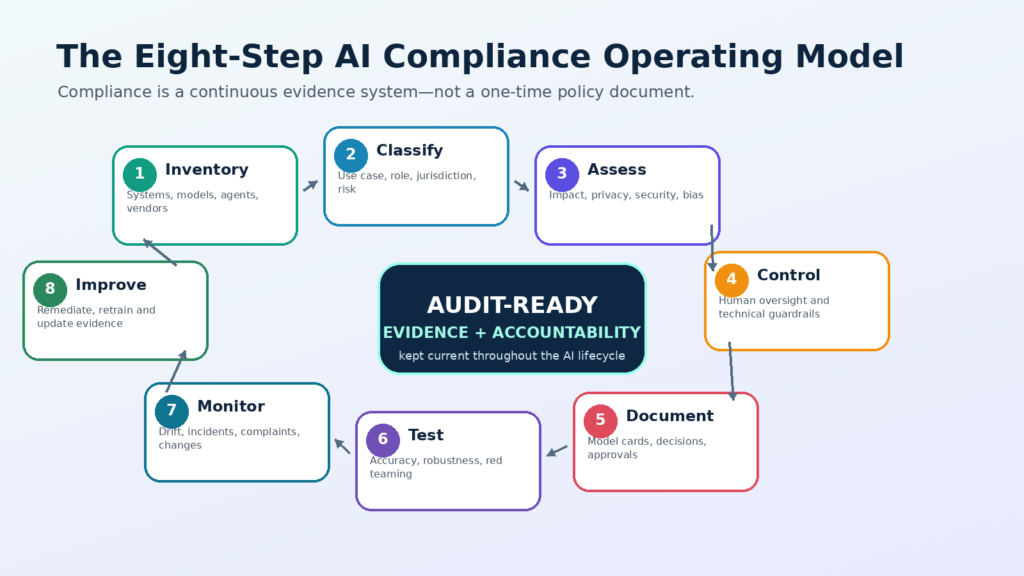
Figure 2. An eight-step model for converting AI requirements into repeatable governance and evidence.
1. Inventory every AI system and use case
Record the system name, model and version, owner, purpose, users, affected people, data sources, vendor, integration points, jurisdictions and whether the tool can take autonomous actions. Include embedded AI features and unofficial “shadow AI,” not only centrally approved products.
2. Classify role, risk and applicable law
Determine whether the organization is acting as provider, developer, deployer, distributor or product manufacturer. Classify the use case under applicable law and sector rules. A general-purpose model may be low risk in one use case and part of a high-impact decision process in another.
3. Perform impact and rights assessments
Assess foreseeable harm, privacy, discrimination, safety, security, accessibility, misinformation, copyright and consumer effects. Document who may be affected, how severe an impact could be, how likely it is and what controls reduce the risk.
4. Design human and technical controls
Controls may include approval gates, fallback processes, access restrictions, retrieval constraints, content filters, rate limits, output verification, confidence thresholds, user notices, provenance metadata, logging and manual review for consequential decisions.
5. Document decisions and accountability
Keep a classification memo, risk-acceptance decision, system card, data documentation, testing summary, control owner, approval date and review schedule. Record why the system was considered acceptable—not only the final conclusion.
6. Test before and after deployment
Evaluate accuracy, robustness, bias, prompt injection, data leakage, unsafe tool use, model drift and failure modes relevant to the actual context. Generic vendor benchmarks are not a substitute for use-case testing.
7. Monitor incidents, changes and complaints
Track model updates, prompt changes, connected tools, new data sources, user complaints, human overrides, harmful outputs, near misses and vendor notices. Define triggers for suspension, escalation or reassessment.
8. Improve the program continuously
Update controls when requirements, systems or risks change. Retire unused tools, remediate gaps, refresh training and keep the evidence pack synchronized with production reality.
What an Audit-Ready Evidence Pack Should Contain
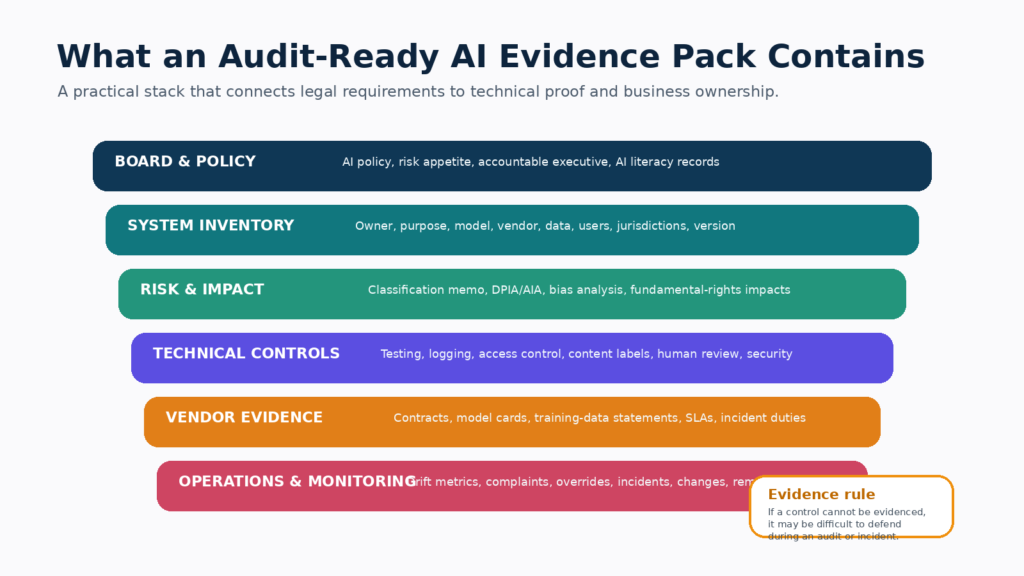
Figure 3. AI compliance evidence should connect governance, system facts, testing and operational monitoring.
- Approved AI policy and risk appetite
- Named accountable executive and system owner
- AI inventory with versions, vendors and jurisdictions
- Provider/deployer classification memo
- Risk or impact assessment and review date
- Privacy assessment and lawful-basis analysis where personal data is involved
- Training-data, model-card and supplier documentation
- Security architecture and access-control evidence
- Testing plan, results, limitations and approval thresholds
- Human-oversight design and reviewer instructions
- User notices, disclosure text and synthetic-content labelling evidence
- System logs, monitoring metrics and change history
- Incident-response and regulator-notification procedures
- Vendor contract clauses, audit rights and incident duties
- AI-literacy training records
- Complaint, appeal, correction and remediation records
Provider vs. Deployer: Why the Distinction Matters
Many compliance failures begin with the assumption that the AI vendor is responsible for everything. Laws frequently divide duties between the organization that develops or places a system on the market and the organization that uses it in a real decision or service. A deployer may need to follow usage instructions, monitor operation, maintain human oversight, keep logs, provide notices and perform its own impact assessment—even when it did not train the underlying model.
| Area | Provider/developer focus | Deployer/user focus |
|---|---|---|
| System design | Intended purpose, model limitations, technical documentation | Confirm use matches intended purpose and local context |
| Data and testing | Training-data summary, validation, known limitations | Use-case testing, local data quality and affected-population risks |
| Human oversight | Design oversight features and instructions | Appoint trained reviewers and ensure they can intervene |
| Monitoring | Provide performance and incident information | Monitor real-world outcomes, complaints and drift |
| Changes | Document model and product modifications | Reassess integrations, prompts, workflows and changed use cases |
| Transparency | Enable required disclosures and provenance | Present notices at the correct user touchpoints |
Why Agentic AI Creates a New Compliance Problem
Traditional AI often produces a recommendation or piece of content. Agentic AI can plan, call external tools, retrieve data, send messages, update records, make purchases or trigger other systems. This expands the compliance boundary from the model’s output to the full action chain.
An agent inventory should therefore record:
- Every external tool, API and database the agent can access
- Actions the agent may execute without approval
- Permission scopes and credential ownership
- Data transferred between models, vendors and jurisdictions
- Decision points where a human can stop or reverse an action
- Logs linking user instructions, model reasoning artifacts where retained, tool calls and final outcomes
- Limits for spending, messaging, data modification and high-impact actions
- Behavior when a tool fails, conflicts with policy or returns unexpected data
| Agentic AI control principleDo not treat a multi-agent workflow as one black box. Map the complete chain of models, prompts, tools, data transfers, decisions and affected people. Compliance scope follows the system’s real behavior—not its marketing name. |
Shadow AI: The Inventory Problem Compliance Teams Cannot Ignore
Employees can activate AI features inside productivity suites, browsers, design platforms, customer-service tools and no-code automations without a formal procurement process. This “shadow AI” creates hidden data transfers, unreviewed vendors and undocumented decision logic. The first control is not a ban; it is a practical discovery process combined with approved alternatives.
- Survey teams by workflow, not only by product name
- Review SaaS contracts and feature-release notes for newly enabled AI
- Monitor browser extensions and OAuth integrations where permitted
- Provide an easy route for employees to register new use cases
- Separate experimentation from production or consequential decisions
- Prohibit sensitive-data entry into unapproved public tools
- Reassess systems when an ordinary software update adds AI automation
AI Compliance Metrics That Show Whether the Program Works
A dashboard should measure coverage and control performance, not only the number of policies written. Useful metrics include:
| Metric | What it reveals |
|---|---|
| Inventory coverage | Percentage of business units and known AI-enabled tools recorded |
| Owner coverage | Percentage of systems with a named business and technical owner |
| Classification completion | Percentage with jurisdiction, role and risk classification |
| Assessment freshness | Percentage of assessments reviewed within the required period |
| Control-test pass rate | Controls passing design and operating-effectiveness tests |
| Vendor evidence coverage | Critical vendors with complete model, security and incident documentation |
| Human-review rate | High-impact outputs receiving required review before action |
| Override and appeal rate | Frequency of human overrides, user challenges and corrections |
| Incident response time | Time from detection to containment, assessment and notification decision |
| Change-review coverage | Material model, prompt or workflow changes reviewed before release |
| Training completion | Relevant personnel completing role-based AI literacy training |
| Evidence age | Time since key documents and logs were last validated |
What YouTube and Reddit Research Adds
Official sources establish what the law or framework says. YouTube demonstrations, conference videos and practitioner communities are more useful for identifying implementation questions, vocabulary and operational friction. They should be treated as research leads—not final legal authority.
Recent practitioner discussions repeatedly focus on three problems: organizations do not have a complete AI inventory; provider-versus-deployer responsibilities are confusing; and teams struggle to collect current evidence across engineering, legal, security, procurement and business operations. Other discussions highlight the difficulty of applying chatbot and synthetic-content disclosure requirements to multi-agent and voice interfaces.
Useful practitioner discussion: What is the hardest part of EU AI Act compliance?
Evidence-management discussion: Are teams automating EU AI Act compliance evidence?
Framework explainer video: Overview of the NIST AI Risk Management Framework
When using these sources in a published article, summarize the issue, remove promotional claims, verify deadlines against official material and avoid presenting anonymous comments as representative survey data.
Common AI Compliance Mistakes
Using one deadline for the entire EU AI Act
Different provisions apply on different dates. Maintain an obligation-level calendar.
Treating vendor approval as the end of compliance
The deployer must evaluate the actual workflow, local data, affected people and human oversight.
Creating an inventory once
AI features, versions, prompts, integrations and user groups change. Inventory must be continuously maintained.
Relying on a policy without technical controls
A written rule cannot prevent data leakage, unauthorized tool calls, missing labels or unlogged decisions.
Testing only model accuracy
Compliance also requires security, bias, robustness, privacy, transparency and human-factors testing.
Ignoring ordinary laws
Consumer protection, employment, privacy, civil rights, intellectual property and sector requirements apply even where no AI-specific act exists.
Keeping no evidence of decisions
A conclusion without supporting records is difficult to defend during an audit, complaint or incident.
Assuming “human in the loop” is enough
The reviewer must have time, information, authority and competence to challenge the system rather than rubber-stamp it.
A 90-Day AI Compliance Roadmap
| Phase | Actions |
|---|---|
| Days 1–15: Discover | Appoint an accountable lead, identify jurisdictions, survey AI use, collect vendor lists and create an initial system inventory. |
| Days 16–30: Prioritize | Classify systems by impact and legal role. Flag employment, lending, healthcare, education, biometrics, public services, children, surveillance and autonomous-action use cases. |
| Days 31–50: Assess | Complete impact, privacy and security assessments for priority systems. Identify missing documentation and supplier information. |
| Days 51–70: Control | Implement user notices, content labels, access restrictions, human review, testing, logging and incident procedures. |
| Days 71–85: Evidence | Create system cards, approval records, control maps, vendor files, training records and audit-ready evidence folders. |
| Days 86–90: Govern | Report material risks to leadership, accept or remediate gaps, set monitoring metrics and schedule reassessment after significant changes. |
Frequently Asked Questions
What is AI compliance?
AI compliance is the combination of legal, technical and organizational controls used to ensure AI systems follow applicable laws, standards, contracts and internal policies throughout their lifecycle.
What is the most important AI compliance deadline in August 2026?
In the EU, Article 50 transparency duties become applicable on August 2, 2026, and the Commission’s enforcement powers for general-purpose AI provider obligations also begin. High-risk-system deadlines follow a different schedule.
Did the EU delay the entire AI Act?
No. The EU extended important high-risk-system deadlines, but other requirements—including AI literacy, prohibited practices, GPAI obligations and Article 50 transparency—follow separate dates.
Does the EU AI Act apply to companies outside Europe?
It can apply where statutory territorial-scope conditions are met, including certain situations involving systems or outputs used in the EU. Businesses should obtain legal advice for their specific structure and market activity.
Is ISO/IEC 42001 legally required?
ISO/IEC 42001 is generally a voluntary management-system standard unless a contract, procurement rule or sector requirement makes it mandatory. It can support structured governance but does not automatically prove compliance with every law.
What is an AI impact assessment?
It is a documented evaluation of an AI system’s intended use, affected people, foreseeable benefits and harms, data, performance, discrimination, privacy, security, human oversight and mitigation measures.
What evidence should an AI vendor provide?
Depending on risk, request system and model documentation, intended-use information, limitations, testing results, security controls, data information, change notices, incident obligations, audit rights and support for required disclosures.
How often should an AI system be reassessed?
Use a risk-based schedule and reassess after material changes such as a new model, changed prompt or workflow, new data, new jurisdiction, new affected population, expanded autonomy, serious incident or significant performance drift.
Can a company use AI for compliance work?
Yes, AI can support monitoring, classification and evidence management, but the compliance tool itself should be governed. Validate outputs, protect sensitive data, retain human accountability and log material decisions.
Is this article legal advice?
No. It is an educational summary based on public sources available as of July 27, 2026. Legal obligations depend on jurisdiction, role, sector, system design and use case.
Conclusion: Compliance Must Follow the Real AI System
AI compliance in 2026 is defined by fragmentation and operational detail. Some rules are already active. Others apply in August 2026, January 2027, December 2027 or later. The safest response is not to wait for one universal deadline. Build a system that can identify new obligations, map them to specific AI use cases, implement controls and continuously produce evidence.
Organizations that understand their AI inventory, document why each use case is permitted, test systems in context and preserve human accountability will be better prepared for regulators, enterprise customers, procurement reviews and incidents. Those that rely on vendor marketing, generic policies or outdated spreadsheets may discover that the hardest compliance problem is not the law—it is proving what their AI actually does.
| Publishing update recommendationReview this article monthly and immediately after major regulator guidance, court decisions, enforcement actions or amendments. Put a visible “Last updated” date near the title and keep a change log for material corrections. |
Research and Editorial Methodology
The article prioritizes primary sources: official regulator pages, enacted legislation, government publications, NIST and ISO. Secondary and community sources are used only to identify practical questions and industry concerns. Dates and legal status were checked against official pages available on July 27, 2026. Predictions and operational recommendations are clearly separated from statements about enacted rules.
Sources and References
1. European Commission — Navigating the AI Act
2. European Commission — AI Act regulatory framework
3. European Commission — Transparency code for AI-generated content
4. European Commission — Guidelines for GPAI providers
5. Colorado Attorney General — ADMT and Chatbot Safety rulemaking
6. Colorado General Assembly — SB 26-189
7. Texas Legislature — HB 149 enrolled text
8. California Legislature — AB 2013
9. California Legislature — SB 942
10. California Attorney General — Frontier AI safety requirements
11. White House — America’s AI Action Plan
12. OMB — M-25-21 Federal AI governance memorandum
13. ICO — 2026 ADM guidance consultation
14. UK Government — Agentic AI and consumers
15. UK Government — Financial Services AI Adoption Plan
16. NIST — AI Risk Management Framework
17. NIST — Generative AI Profile