

Introduction – Why Your Startup Needs More Than Just a Spreadsheet
Let me be honest with you. When you start a new business, everything feels exciting. You get your first 10 customers, then 20, then 50. You are managing everything in your head, in WhatsApp chats, in Google Sheets, and in sticky notes on your laptop.Then one day, it breaks.
You forget to follow up with a hot lead. A customer emails you, but you reply three days late. Your co-founder asks, “Did we send that proposal?” and nobody knows the answer. That is the exact moment most startups realize they need a CRM.
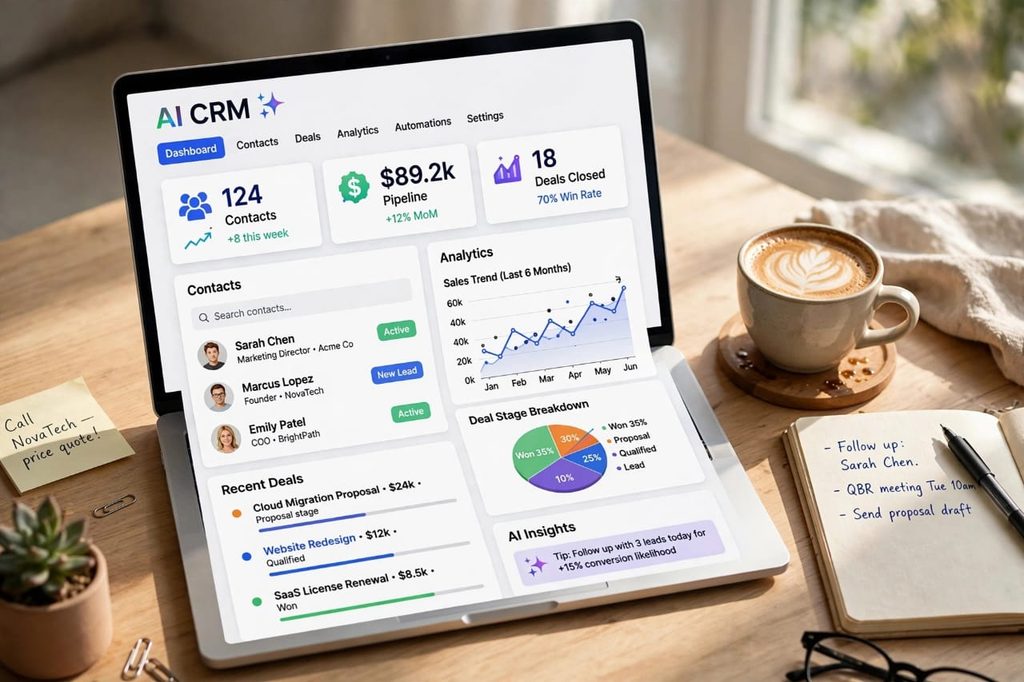
But not just any CRM. In 2026, a normal CRM is not enough. You need an AI CRM. A tool that does not just store contacts, but actually thinks with you. It reminds you, it writes your follow-up emails, it tells you which lead is most likely to buy, and it saves you 10+ hours every single week.
In this guide, I have tested and compared the 7 best AI CRM software for startups. These are not big, expensive enterprise tools. These are tools made for small, fast-moving teams who want to grow without hiring a huge sales team.
What is an AI CRM, Really
The Simple Definition
A normal CRM is like a digital address book. An AI CRM is like a smart assistant + address book combined.
It can:
Automatically capture leads from your website, email, and forms
Score your leads and tell you who is ready to buy
Write personalized follow-up emails in seconds
Summarize your calls and meetings automatically
Predict which deals will close and which will be lost
For a startup founder who is doing sales, marketing, and support all at once, this is a game-changer.
Why Startups in 2026 Cannot Ignore AI CRM
In 2026, your competitors are using AI. If you are still doing manual data entry, you are already behind. A good AI CRM helps you reply faster, follow up smarter, and never lose a lead again. And in the early days, one lost lead can mean one month of lost revenue.
How to Choose the Right AI CRM for Your Startup
Before we go to the list, let’s talk about what actually matters. Don’t choose a CRM just because it looks fancy. Choose it based on these 5 things:
1. Ease of Use: If your team needs 2 weeks of training to use it, it’s the wrong tool. You need something you can set up in one afternoon.
2. Price: Startups need to be careful with money. Look for a free plan or a plan under $30 per user per month to start.
3. AI Features That Save Time: Not all “AI” is useful. Look for AI email writing, lead scoring, and meeting summaries. Those are the features you will use daily.
4. Integrations: Your CRM must connect with Gmail, Slack, Zoom, Stripe, and your website. If it doesn’t, you will waste time copying data.
5. Room to Grow: You might be 3 people today, but 30 people next year. Your CRM should grow with you without forcing you to switch tools later.
The 7 Best AI CRM Software for Startups in 2026
1. HubSpot CRM – Best Overall for Startups
HubSpot is still the king for startups in 2026, and for a good reason. Its free plan is genuinely powerful. You get contact management, email tracking, live chat, and now, a very strong AI assistant called Breeze.
Breeze can write emails, summarize deals, and even help you create reports. For a new startup, HubSpot is the safest choice because it is easy, trusted, and it scales from 0 to 100 employees.
Best for: Startups that want an all-in-one tool for sales, marketing, and support.
Pricing: Free plan available, paid plans start around $20/month.
Pros: Free plan, very easy to learn, great integrations.
Cons: Advanced features get expensive as you grow.
2. Pipedrive – Best for Sales-Focused Teams
If your startup is all about selling, Pipedrive will feel like home. Its visual pipeline is so simple that you can see your entire sales process in one glance. In 2026, its AI features have become really smart. It suggests the next best action, predicts deal win rates, and writes follow-up emails for you.
I personally love Pipedrive for small sales teams because it keeps everyone focused. No clutter, no confusion. Just deals moving forward.
Best for: Startups with a dedicated sales team.
Pricing: Starts around $14/month per user.
Pros: Super visual, great for deal tracking, strong AI sales assistant.
Cons: Less powerful for marketing automation.
Zoho CRM – Best Value for Money
Zoho is the best option if you are on a tight budget but still want powerful AI. Its AI assistant, Zia, can predict sales, detect anomalies, and even tell you the best time to contact a customer. For the price, Zoho gives you features that other tools charge double for.
Many startups in Asia and Europe choose Zoho because it is affordable and it offers a full suite of business apps.
Best for: Budget-friendly startups that want powerful AI.
Pricing: Free for up to 3 users, paid plans start around $14/month.
Pros: Very affordable, powerful AI, many integrations.
Cons: Interface can feel a little old compared to others.
4. Salesforce Starter – Best for Startups That Plan to Scale Big
Salesforce used to be only for big companies. Not anymore. Their Starter plan in 2026 is built for small teams. You get Einstein AI, which is one of the most advanced AI systems in the CRM world. It can score leads, forecast revenue, and automate repetitive tasks.
If you dream of building a big company and you want a CRM that will never need to be replaced, Salesforce Starter is a smart long-term investment.
Best for: Ambitious startups planning rapid growth.
Pricing: Starts around $25/month per user.
Pros: Most powerful AI, industry standard, endless customization.
Cons: Can feel complex for very small teams.
5. Attio – Best Modern CRM for Tech Startups
Attio is the new favorite of tech startups. It looks beautiful, it is incredibly fast, and it feels more like Notion than a boring old CRM. Its AI automatically builds rich profiles for your contacts by pulling data from LinkedIn, emails, and the web.
If you are a SaaS startup, a fintech startup, or an agency, Attio will make your team actually enjoy using a CRM.
Best for: Modern SaaS and tech startups.
Pricing: Free plan available, paid plans start around $29/month.
Pros: Beautiful design, smart data enrichment, highly customizable.
Cons: Newer tool, fewer integrations than HubSpot.
Freshsales (Freshworks) – Best for AI Automation
Freshsales is perfect if you hate manual work. Its AI, Freddy, can automatically assign leads, send follow-up emails, and even chat with website visitors. You set it up once, and it keeps working for you in the background.
For a solo founder or a team of 2-3 people, Freshsales feels like having an extra employee who never sleeps.
Best for: Solo founders and small teams who need automation.
Pricing: Free plan available, paid plans start around $15/month.
Pros: Great automation, AI chatbot included, easy setup.
Cons: Reporting is not as deep as HubSpot.
Monday Sales CRM – Best for Teams Who Love Visual Work
If your team already uses Monday.com for project management, Monday Sales CRM is a natural choice. It is colorful, visual, and very flexible. Its AI can summarize long email threads, generate sales reports, and help you prioritize your day.
It is not the most traditional CRM, but for creative startups and agencies, it works wonderfully.
Best for: Creative teams and agencies.
Pricing: Starts around $12/month per user.
Pros: Visual and fun to use, great for collaboration, good AI summaries.
Cons: Can get messy if you have a very large pipeline.
Quick Comparison: Which AI CRM is Best for You
If you want a quick overview, here is how these tools compare. HubSpot CRM is the best overall choice because it has a free plan and starts around 20 dollars per month, with very strong AI features. Pipedrive is best for sales teams, it has no free plan and starts around 14 dollars per month. Zoho CRM is the best budget option, it has a free plan and also starts around 14 dollars per month.
Salesforce Starter is best for startups that plan to scale big, it has no free plan and starts around 25 dollars per month with excellent AI. Attio is best for modern tech startups, it has a free plan and starts around 29 dollars per month.
Freshsales is best for automation, it has a free plan and starts around 15 dollars per month. Finally, Monday Sales CRM is best for visual teams, it has no free plan and starts around 12 dollars per month. In short, if you want free and safe, choose HubSpot, if you want cheap and powerful, choose Zoho, and if you want modern and smart, choose Attio.
My Honest Recommendation – Which One Should You Pick?
After testing all of them, here is my simple advice:
If you are just starting and you want something free and safe, go with HubSpot. You cannot go wrong with it.
If you are focused only on sales and closing deals, go with Pipedrive.
If money is tight and you want the most value, go with Zoho CRM.
If you are building a tech SaaS product and you want something modern, go with Attio.
Don’t overthink it. The best CRM is the one your team will actually use every day. Pick one, set it up this week, and import your contacts. You will see the difference in just 7 days.
Common Mistakes Startups Make With CRM
1. Buying the Most Expensive Plan on Day One
You don’t need the $100 per user plan when you have 10 customers. Start small. Upgrade when you grow.
Not Entering Data Daily
A CRM is only as good as the data inside it. Spend 10 minutes at the end of each day to update your deals. AI can help, but it cannot guess everything.
3. Choosing a Tool Nobody Likes
If your team hates the tool, they will not use it. Let your team try 2-3 options before you decide.
Final Thoughts – Your Customers Are Your Biggest Asset
At the end of the day, your startup is not about your product. It is about your customers. The companies that win in 2026 are not the ones with the best product, they are the ones who understand their customers the best and respond the fastest.
An AI CRM helps you do exactly that. It helps you remember every conversation, follow up at the right time, and make every customer feel important.
So, don’t wait. Pick one tool from this list, start your free trial today, and take the first step towards building a customer-obsessed startup.
Your future customers are waiting for you.
[…] next step automatically. In this guide, we will compare the 7 best AI workflow automation tools for SaaS teams in 2026, so you can choose the right one without wasting time or […]